Where the six fishing spots in Bobber Rise come from in real Korean life, what the words mean, what the game invents, and the numbers that change from pond to pond.
Bobber Rise has six fishing spots: Morning Pond, Paddy Brook, Valley Rapids, Ferry River, East Sea Rocks and South Sea Isles. Each one is a kind of water that Koreans have lived beside for a very long time. When the JWorld team picked the spots, the idea was to walk one line through Korea's waters: a village pond first, then rice paddies, a mountain stream, a river, the East Sea and finally the South Sea.
This article keeps two things apart. One is the words and history of these waters. The other is what the game invents. Old sources do not always agree, so anything uncertain is marked with "is said to" or "according to records".
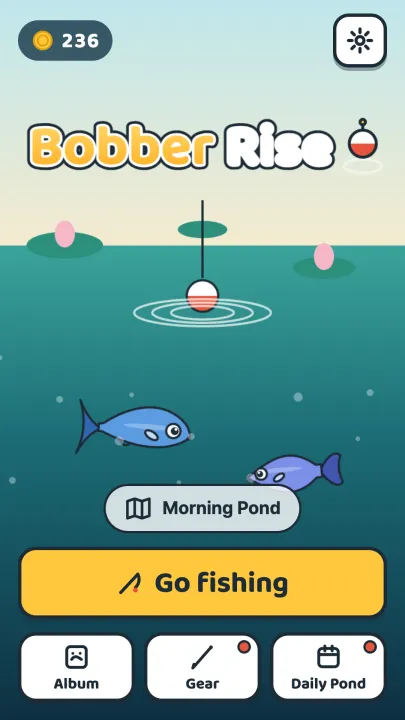
The six spots at a glance
First the numbers inside the game. You unlock each pond with coins and with a number of species already in your album. These are the real values from the code.
| # | Spot | To unlock | Fish | New pull style met here |
|---|---|---|---|---|
| 1 | Morning Pond | open from the start | 30 species | Steady, Swaying |
| 2 | Paddy Brook | 100 coins + 10 species | 30 species | Charging |
| 3 | Valley Rapids | 250 coins + 30 species | 30 species | Thrashing |
| 4 | Ferry River | 500 coins + 55 species | 30 species | Diving |
| 5 | East Sea Rocks | 900 coins + 72 species | 30 species | all five mixed |
| 6 | South Sea Isles | 1,500 coins + 98 species | 30 species | all five, heavier |
Every spot holds 30 species, so the Album totals 180. Coins alone are not enough to open a pond, because the album has to grow too. That nudges you to get to know the fish in one place before you move on.
1. Morning Pond: lotus and dragonflies
The first spot is a pond close to the village. The game paints lily pads and pink buds on the surface.
Ponds were a normal part of old Korean gardens. According to records, palace gardens such as Buyongji at Changdeokgung held lotus ponds, and the name 부용 (buyong) is a word for the lotus flower. A pond was something to look at, and also a place to store water.
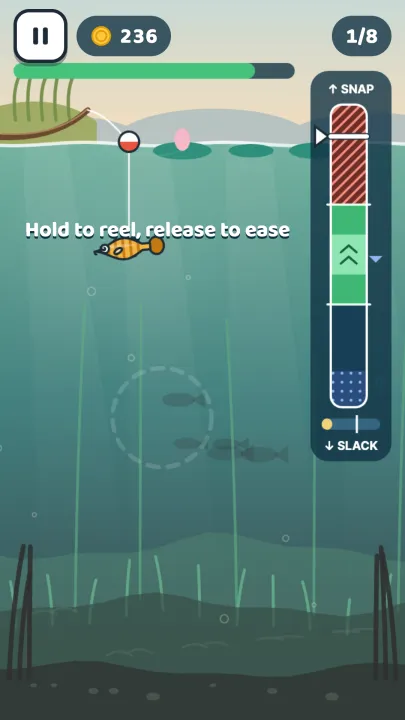
In the game this is the practice water. It only uses the two gentlest pull styles, and Common fish are most of what you see.
- Steady: the fish pulls with an even force.
- Swaying: the force drifts slowly up and down.
If you learn only these two here, the hold-and-release rhythm settles into your hands. Fish values here are also the base values, with no multiplier.
2. Paddy Brook: where Charging begins
A 논두렁 (nondureong) is the raised earthen ridge between two rice paddies. It holds the water in, and people walk along it. Next to it run the small ditches and brooks that feed the fields.
Korea grew rice for a very long time, and the water around paddies is a common memory of childhood play. So this spot shows rice terraces and frogs.
From here on, fish can bolt. The style is called Charging. A fish stays calm, then pulls hard in one go. You have to see the tension coming and ease off first. A warning cue appears on the fish before it happens.
Here is something the game invents. Every fish name in the brook is a name we made up. These are not drawings of real fish. They are pocket-sized cartoon fish, so the game makes no claim about which species lives in a real paddy brook.
3. Valley Rapids: clear water and mist
A 여울 (yeoul) is a shallow, fast stretch of a stream. The stones show on the bottom and the water is loud. Mountain valleys are full of them.
The game's rapids use clear water and mist. This is also where the first Legend fish appears, at roughly 1 in 100 hooked fish.
The new style here is Thrashing. The line twitches in short, frequent bursts, so one long hold stops working. You need to press and release on the fish's beat.
4. Ferry River: where boats crossed
A 나루 (naru) is a landing where ferries cross a river or a narrow strait. The boatman is called a 사공 (sagong). In the days before many bridges, crossing a big river meant going through a ferry landing.
Travelers gathered at landings, and little shops grew up around them. That is also why the first town of our idle game Dokkaebi Tavern is a ferry landing.
Ferry River in Bobber Rise is slow and wide. Here the game teaches Diving: the fish drives downward and the line tightens in an instant.
Now the money. Each pond multiplies fish values by a different number. Ferry River is ×2.1.
| Spot | Value multiplier | Common fish | Legend fish |
|---|---|---|---|
| Morning Pond | ×1 | 4 coins | none |
| Paddy Brook | ×1.3 | 5 coins | none |
| Valley Rapids | ×1.7 | 7 coins | 306 coins |
| Ferry River | ×2.1 | 8 coins | 378 coins |
| East Sea Rocks | ×2.4 | 10 coins | 432 coins |
| South Sea Isles | ×2.9 | 12 coins | 522 coins |
The base is 4 coins for Common and 180 for Legend, rounded after the multiplier. Hard spots pay more per fish.
5. East Sea Rocks: stone and gulls
A 갯바위 (gaetbawi) is a rock exposed along the shore. Rock fishing, where an angler stands on those rocks and casts into the sea, is well known in Korea.
The east coast of the peninsula is known for a fairly straight shoreline where the water gets deep quickly. The west and south coasts are more broken, with many islands. The game paints the East Sea as rocks and gulls.
From here, all five pull styles you have learned show up mixed together. The fish mix changes with each spot too.
| Spot | Common | Uncommon | Rare | Epic | Legend |
|---|---|---|---|---|---|
| Morning Pond | 70% | 25% | 5% | 0% | 0% |
| Valley Rapids | 45% | 35% | 15% | 4% | 1% |
| East Sea Rocks | 25% | 35% | 25% | 12% | 3% |
| South Sea Isles | 15% | 30% | 30% | 18% | 7% |
Those are rarity shares for every 100 hooked fish. In the South Sea only 15 are Common, while 55 are Rare or better.
6. South Sea Isles: the last water
Korea's southern sea is dotted with islands, and that archipelago is often called 다도해 (dadohae). So the last spot is South Sea Isles. The game shows a night glow drifting between island silhouettes. That glow is the game's own invention.
This is the hardest water. The pull mix is 30% Diving, 25% Charging and 25% Thrashing. The gentle Steady and Swaying styles add up to only 20%. Bring your best gear.
What changes within a spot: distance and time
Some rules apply everywhere. When you cast, the power meter splits into three zones, Near, Mid and Far. Different fish prefer different distances, so even in one pond the blanks in your album fill up depending on where you throw. The time of day (day, dusk, night) and rain also change, so the same spot looks different on different visits.
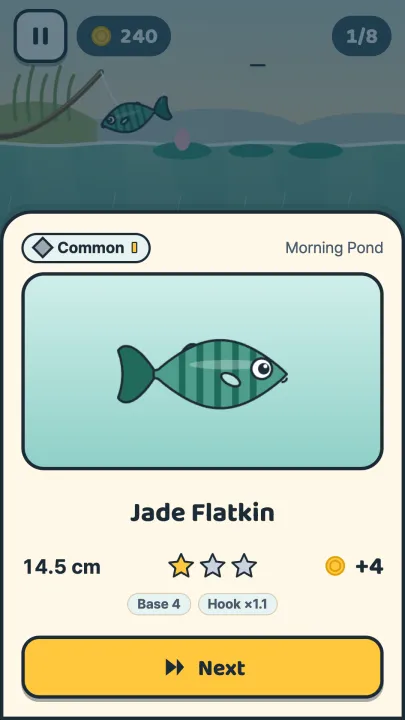
Each Album card lists a Habitat, so when a page stays blank you know which spot to revisit. The fish names are ours, so do not read them as real species.
Summary
- The six spots follow real Korean waters: pond, paddy, mountain rapids, ferry landing, East Sea and South Sea.
- Each spot has 30 species, 180 in the Album in total.
- Pull styles arrive in order: Steady and Swaying at the pond, then Charging, Thrashing and Diving.
- Opening a pond needs both coins and a species count.
- The value multiplier climbs from ×1 to ×2.9, and rarer fish become more common with it.
- The old words are real history. The fish names and the night glow are the game's inventions.
You can play Bobber Rise on the web right now. Start at Morning Pond, then open the road to the next water.
Written by the JWorld team from our game design documents and measured play data, with AI tools helping with the writing.