How the Daily Run in Frame Breaker hands every player the same ball and bricks without a server, with the score formula, the clock-cheating rules behind the streak, and the emoji result you can share.
Most people assume a "daily challenge" needs a server to hand out today's puzzle. The Daily Run in Frame Breaker does not have one. A date string is enough: on the same day, every device opens exactly the same board.
This dev note walks through how the JWorld team built it. Everything here comes from the game's own code (daily.ts, dates.ts, share.ts) and its design document.
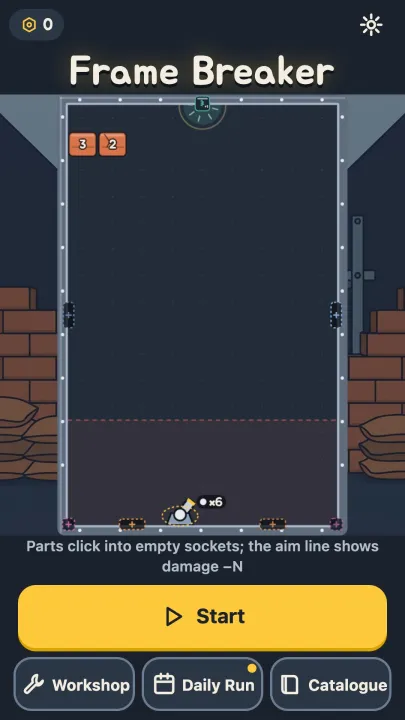
The date is the seed
Every brick layout and every part offer in the game comes from one number, a seed. Same seed, same run. The Daily Run builds that seed from the date.
- The date is the device's local date (
YYYY-MM-DD). - The seed is a 32-bit hash of a string such as
ballbreak-daily:2026-11-22. - The ball is fixed by the date too. The game has six balls (Steel Ball, Anvil, Glass Ball, Drill, Pop and Compass), and the day number is hashed to pick one.
- Heat is 0 and there are no Workshop upgrades, so everyone starts level.
That is why the screen says "The same ball and bricks every day. No bolts, just a score." Bolts, the upgrade currency, are not given in the Daily Run. It is a design rule, and it also means the ad reward that adds starting balls is switched off there, so nobody gets a head start.
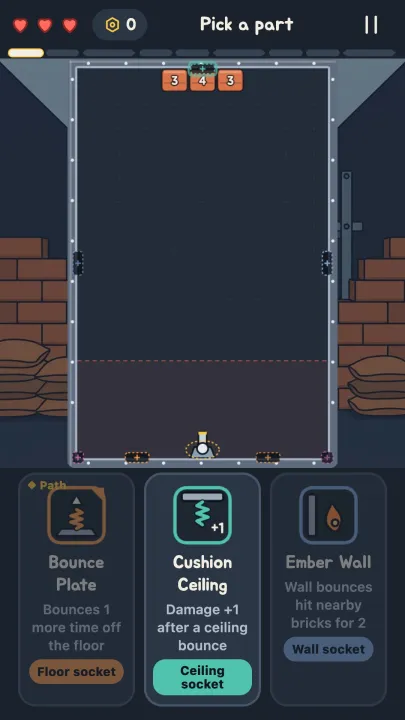
The three-part offers follow the seed's order as well. Parts you have not unlocked yet are filtered out of the candidates, but the order the seed chose stays fixed.
The core never reads a clock
The rules code never calls Date. The screen layer reads the date and passes it in as a string. Calendar math is done by hand with integers.
| Job | How |
|---|---|
| Check a date is real | Only real calendar dates from 2000 to 2999 count |
| Add a day | Convert to days since 1970-01-01, add, convert back |
Run number #n | A running count where 2026-01-01 is #1 |
Because of this, tests can feed in any date they like. Tricky cases such as "a run started at 23:59" are reproduced with a single string.
The score is one line
- Stages cleared × 100
- Hearts left × 30
- Total HP of destroyed bricks ÷ 10, rounded up
- +300 if you clear all nine stages
Clear four stages with two hearts left and 421 HP of bricks destroyed, and you get 400 + 60 + 43 = 503. Stage progress carries the biggest weight on purpose, so surviving longer beats merely breaking lots of bricks.
You get one free try a day, and "Watch an ad: extra try (1)" gives one more. Either way only your best score for the day is kept, so a bad second run never lowers your record.
Streaks and clock tricks
With no server, the streak ("{n}-day streak") has to trust the device clock. So three rules keep a changed clock from doing damage.
- A run counts on the day it ended. A run that starts at 23:59 and finishes after midnight is recorded for the next day.
- Turning the clock back does not help. If today looks earlier than your last finished day, the last finished day is treated as today. You cannot rewind the clock for a second free run.
- A far-future clock is ignored. If the last recorded day is three or more days ahead of today (
MAX_AHEAD_DAYS = 2), it is treated as a mistake and dropped. Without this rule, someone who once set the clock months ahead by accident would be locked out of the Daily Run for months.
The streak adds 1 if you finished yesterday, stays the same if you already finished today, and restarts at 1 after a missed day. Everything is stored on the device, and only the most recent 400 days of daily records are kept.
An emoji line instead of a leaderboard
When everybody plays the same board, people want to compare. With no server, the result becomes text you can paste anywhere. The share button produces something shaped like this:
`` Frame Breaker #326 ❤2/3 🔩503 🟩🟩🟩 🟩🟥⬜ ⬜⬜⬜ ``
(That is a sample to show the format.) The first line holds the run number, hearts left and score, and nine squares follow in three rows. 🟩 is a cleared stage, 🟥 is the stage where the run ended, and ⬜ is a stage never reached. It spoils nothing, yet it shows at a glance where your run got stuck. If copying is blocked, the text is shown as selectable text instead.
Summary
- The Daily Run's seed is a hash of the device's local date string, so the same day gives the same board with no server.
- The date fixes one of six balls, and heat 0 with no Workshop upgrades keeps conditions equal.
- Score = stages × 100 + hearts × 30 + brick HP ÷ 10 (rounded up), plus 300 for a full clear.
- Streaks count the day a run ended, treat a rewound clock as the same day and ignore a far-future one.
- Results are shared as nine emoji squares.
Open the "Daily Run" button on the start screen of Frame Breaker and see how many stages you can clear under identical conditions.
Written by the JWorld team from our game design documents and measured play data, with AI tools helping with the writing.