A level-by-level look at how each Hanpan AI opponent plays, what the 3-star goals ask for, and what to do when a level has you stuck, using the in-game wording.
The AI ladder in Hanpan has 20 opponents: ten for Gomoku and ten for Janggi. Beat one and the next opens. Players often say the ladder feels strangely easy at level 3 and then suddenly sharper at level 4. That is not your imagination. The AI changes the way it looks at the board between tiers, and knowing how makes each tier much easier to beat.
The JWorld team read the level tables and the on-screen text to write this guide. Names and descriptions are the ones the game shows today. You can try it in your browser.
How the ladder works
- Each game has ten levels. Level 1 is open from the start, and level n opens when you beat level n−1.
- Every level has three stars. Star 1 is always "Win." Stars 2 and 3 are goals that change from level to level.
- The goals for stars 2 and 3 must all be met in a single game to count. Stars keep your best result.
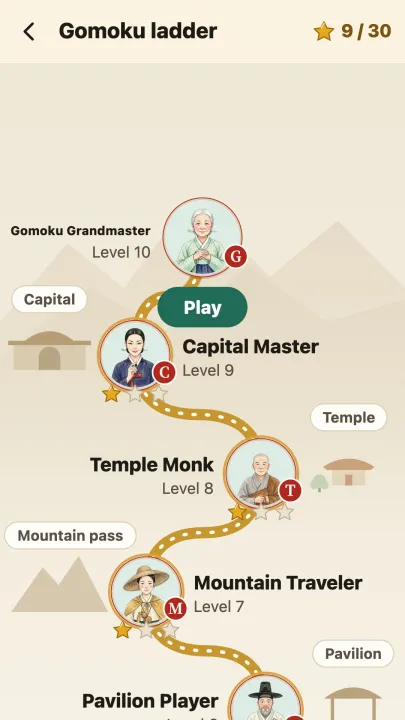
- One game holds 30 stars, so Gomoku and Janggi together hold 60.
- Gomoku uses the rule you picked (No 3-3 by default), and you choose your color on the level sheet.
The goals come in a few kinds:
| Goal type | Wording in the game |
|---|---|
| No helpers | Win without undo / Win without hints / Win without undo or hints |
| Fast | Win within n of your moves (by checkmate in Janggi) |
| Second player | Win as the second player (White / Han) |
| Janggi only | Win without losing a chariot / without losing both chariots / Win by checkmate, not on points |
Levels 1 to 3: the learning tier
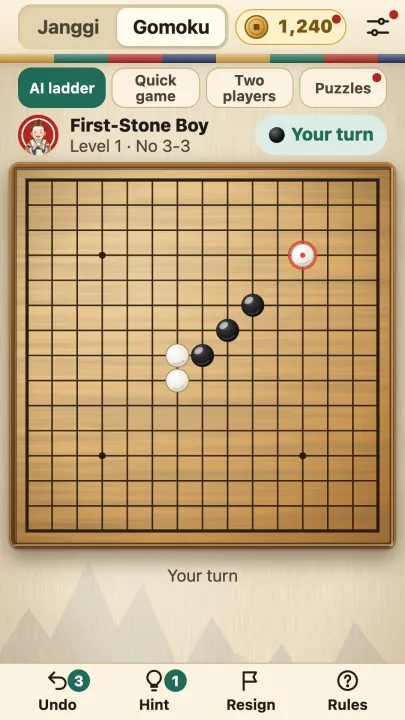
The Gomoku opponents are First-Stone Boy, Market Kid and Village Pupil. All three look only one move ahead, and they make deliberate slips on top of that.
- First-Stone Boy plays anywhere and often misses open threes. He does always block your four, the one move before five in a row.
- Village Pupil looks two moves ahead and now and then wanders off.
- All three always answer an open three while fewer than ten stones are on the board, so nobody loses in a handful of moves. After that, level 1 leaves an open three alone roughly 30% of the time.
Levels 1 and 2 also come with a beginner aid: a dotted red circle marks the point you must block right now, because otherwise the opponent makes five on its next move. From level 3 on the circle is gone. You can also turn it off under "Show points to block (beginner)."
The Janggi opponents are Neighborhood Kid, Alley Brother and Parlor Uncle.
- Neighborhood Kid moves pieces at random and misses free captures. In the first twenty moves he notices a free piece only some of the time.
- Alley Brother takes what is in front but never looks behind. The game's own tip: hide a chariot or cannon behind a bait piece.
- Parlor Uncle loves cannons. Remove the piece a cannon jumps over and it loses its power.
The lesson of this tier is simple. Do not just extend your own line. Build a shape the opponent cannot block. In Gomoku, try making two threes near the center, exactly what the level 1 tip says.
Levels 4 to 6: the calculating tier
This is where the AI changes. Search depth goes up to 3, 3 and 4 plies (a ply is one move by either side), and the chance of a random slip drops to 5%, 5% and 3%. From level 4 the AI also searches for a finishing chain of fours on its own.
| Level | Gomoku opponent | Description |
|---|---|---|
| 4 | Ferryman | Hunts for a finish with fours in a row |
| 5 | Tavern Guest | Reads chains of fours in attack and defense |
| 6 | Pavilion Player | Loves fighting in the center and rarely slips |
Put the game's advice together and you get a plan:
- Ferryman (level 4): block where its fours would connect before they come.
- Tavern Guest (level 5): aim for a point that makes a four and a three at once (4-3).
- Pavilion Player (level 6): gather stones toward a corner and prepare a two-way attack.
On the Janggi side you meet Market Trader (4), Pavilion Elder (5) and Village Teacher (6). The Trader counts every trade, so swapping pieces will not win you anything. Chain checks toward checkmate instead. The Elder guards the palace tightly, so keep your chariots and shake the palace front with horses and elephants. From level 5, Janggi opponents think with a node budget (the number of positions they may examine): 330 at level 5 and 1,400 at level 6.
Levels 7 to 10: the no-mistakes tier
From Gomoku level 7 the AI never makes a random slip. Depth climbs to 5, 6, 8 and 10 plies.
| Level | Gomoku opponent | Depth (plies) | Janggi opponent |
|---|---|---|---|
| 7 | Mountain Traveler | 5 | County Magistrate |
| 8 | Temple Monk | 6 | Bandit Chief |
| 9 | Capital Master | 8 | Capital Champion |
| 10 | Gomoku Grandmaster | 10 | Janggi Grandmaster |
The level 10 Gomoku opponent also uses an opening book, and the Janggi Grandmaster has prepared lines for every setup. The advice from the game is the same for both: do not rush. Against the Gomoku Grandmaster, "as Black, build a solid shape near your first stone." Against the Janggi Grandmaster, "use the first ten moves to develop your pieces evenly."
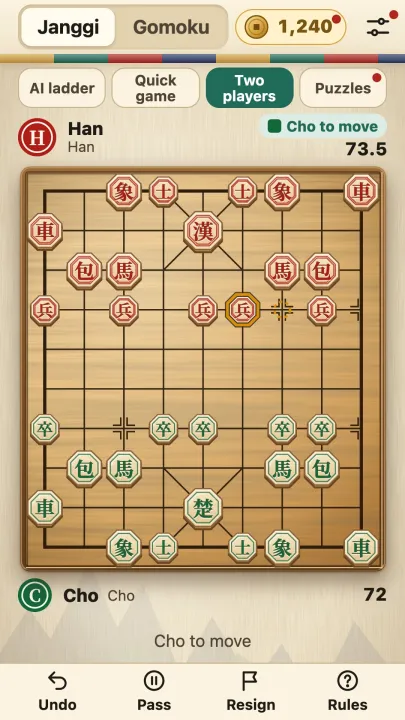
A few Janggi rules matter here. Han sets up first and Cho second, and Cho moves first. Han receives a 1.5-point bonus, so a points count starts at Cho 72 and Han 73.5, and a game cannot end in a draw. Bandit Chief (level 8) plays for bikjang and points, so when it leads on points, never let the generals face each other.
When you are stuck
If you keep losing the same level, the game helps.
- After three losses the opponent-guide button on the level sheet is highlighted. Watch an ad and you get a detailed note on that opponent plus a few hints, kept until you clear the level.
- After five losses the game asks, "Practice against an easier opponent?" and takes you to a quick game.
- Quick game lets you pick any opponent. A win pays coins, but there are no stars.
- The board has Undo and Hint buttons. On levels whose star goal says "without undo," the star only counts if you leave them alone.
If a level's goals are tough, do not chase everything at once. Clear star 1 to open the road, then come back for stars 2 and 3 later. It is less tiring and you will know the opponent better by then.
Summary
- The ladder has 10 Gomoku and 10 Janggi opponents. Level n opens when you beat level n−1.
- Levels 1–3 look one or two moves ahead and slip on purpose. Making two threes works well.
- Levels 4–6 search 3–4 plies and read chains of fours. Block while you build your own line.
- Levels 7–10 make no mistakes. Do not rush, and set up your shape first.
- After three losses use the opponent guide; after five, practice one level down.
- One game holds 30 stars. Take star 1 first and the rest later.
Written by the JWorld team from our game design documents and measured play data, with AI tools helping with the writing.