How the Korean words naru, pogu and hanggu differ, what we know about Han River ferries and tax-grain shipping, and which parts of Harbor Haul's five ports are history and which are our own invention.
Harbor Haul has five ports: Calm Cove, Windward Wharf, Glasswork Pier, Floe Harbor and Storm Gantry. In the Korean version the first one is a pogu (포구), and the game's own screens say "포구 1 · 계약 3" where the English version says "Port 1 · Contract 3". Korean has several words for a place where boats come in, and they are not interchangeable.
This post keeps two things apart: the words and history of Korean waterfronts, and what the game invents. Old records differ from source to source, so where we are not sure we say "according to records" or "is said to".
Naru, pogu and hanggu: three kinds of landing
All three words describe a place where boats touch land. Each one stresses something different.
| Word | Meaning | What it brings to mind |
|---|---|---|
| 나루 (naru) | where a boat crosses a river or narrow water | ferry, boatman, the road on the far bank |
| 포구 (pogu) | a spot on the coast or at a river mouth where boats come and go | fishing boats, trading boats, a small market |
| 항구 (hanggu) | a port with facilities for big ships and cargo | quays, warehouses, cranes |
A naru is about crossing. A pogu is about coming and going. A hanggu adds the equipment. Strictly speaking, a place with a crane standing on it is closer to a hanggu.
The game mixes the words. In Korean its screens use "포구", "항구" and "부두" (the quay where ships tie up and unload). The title's "한 짐" means one load that a person carries on their back or on an A-frame carrier. In a way, the load once carried by hand is now the load hanging from the crane.
Ferries when bridges were rare
When bridges were few, crossing a big river meant going through a ferry landing. The Han River had several. According to records, names such as Nodeul-naru (near Noryangjin), Mapo-naru, Gwang-naru and Samjeondo have been handed down, and some Seoul place names still contain "naru".
Ferry landings drew travelers, so roadside inns and small shops grew up around them. That is why the first village of our idle game Dokkaebi Tavern is a ferry landing.
A few features of a naru:
- The route is fixed. Roads on both banks lead to the same landing.
- A boatman handles the boat. How crossing fares were paid is said to have varied by era and region.
- Some days you could not cross, because of summer floods or river ice.
That last point connects to the game. Wind rocks a boat and winter freezes a river. Waterside weather is not something people control, which is why each port in Harbor Haul gets one weather-like rule of its own.
Joun: carrying tax grain by boat
One reason landings grew into big ports was joun (漕運), the system of shipping grain paid as tax to the capital by boat. According to records, both Goryeo and Joseon ran it, with granaries called jochang on the coast and along rivers.
Boats loaded with grain went up the coast and rivers to Seoul. On the Seoul side, landings along the Han received the cargo, and Mapo is known as one of the busy ones.
There is a link to the game here: cargo comes in different shapes and has to be stacked on a boat. Loading sacks, casks and jars of different shapes, you would probably have put heavy things low and breakable things on top. That is our own guess, not something we found in a record of the rules of the time.
Byeongnando and the treaty ports: harbors that reached overseas
Some landings connected to other countries.
- Byeongnando was an international trading port at the mouth of the Yeseong River in the Goryeo period. According to records, merchants from Song China came here, and Arab merchants are said to have come too.
- Treaty ports: Busan opened in 1876, followed by Wonsan and Incheon. From then on, ports with piers for large steamships appear.
This is roughly when "harbor" became "a place with facilities". Warehouses, railways and machines for lifting cargo followed. Harbor Haul's crane and barge sit at the far end of that story.
What the game invents
From here on it is the game, not history. The five ports of Harbor Haul are not real ports. Names and pictures are ours, and the game says in its credits that the port backdrops were made with generative AI.
Each port adds one new rule.
| Port | New rule | In-game hint (English) |
|---|---|---|
| 1 Calm Cove | none; learn tap and rotate | Calm water, no wind |
| 2 Windward Wharf | wind pushes falling cargo | Wind pushes falling cargo |
| 3 Glasswork Pier | glass breaks, barrels roll then lock | Glass breaks on a hard hit |
| 4 Floe Harbor | the deck is slippery and tilted | The ice deck is slippery and tilted |
| 5 Storm Gantry | swell rocks the barge | Swell: drop as the dot heads for a green end |
Ports unlock with stars. There are 120 stars in total (3 for each of the 40 contracts), and ports 2 to 5 open at 10, 26, 44 and 62 stars. Each port holds 8 contracts.
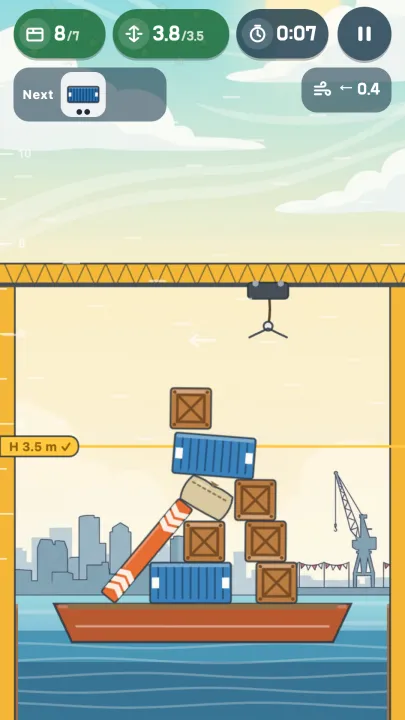
The box at the top right is the wind readout: the arrow shows direction and the number shows strength. Wind pushes only cargo that is still falling. It does not push crates already stacked, so your tower will not suddenly topple because of a gust.
Ice and swell: waterfront weather as rules
Even at old ferry landings, winter ice and strong wind were real obstacles. The game turns that into rules.
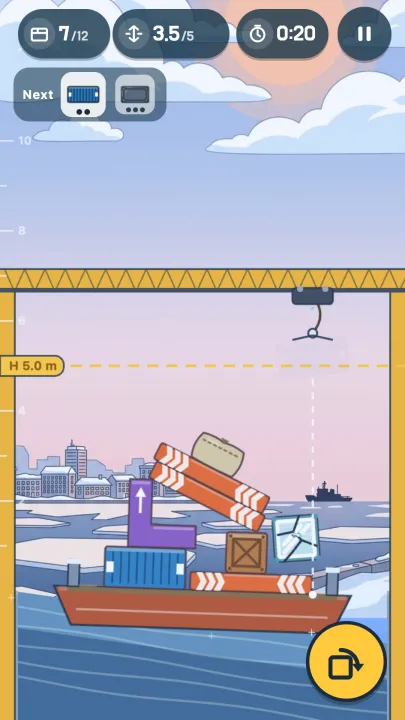
Floe Harbor has very low deck friction, so cargo slides. There are rims 0.6 m high at both ends of the deck, so a sliding crate stops at the end instead of falling into the sea. That number comes from our design document.
On Storm Gantry the barge rolls slowly with the swell. The period is a constant 5 seconds and does not speed up, so you only need to learn the beat. Tap when the dot on the strip heads for a green end, and the cargo lands more steadily.
Tips for getting through the ports
- The first two crates are always a Small Crate, Container or Beam. Use them to build a flat base.
- The flatter the layer below, the easier everything above. The rotate button appears only for cargo whose shape is not symmetric.
- A contract can contain up to three Glass Cases (fewer in the later ports). They break on a hard landing, so set them gently on something stable, not at the top of a tall stack.
- Barrels and buoys roll a moment and then lock. Aim for the middle, not the edge.
- The trolley is fastest in the middle and slowest at the ends. At the ends the hanging crate tilts a little, so releasing near the middle gives a level drop, but you have to time it against the speed.
Summary
- Naru is where you cross a river, pogu is where boats come and go, hanggu is a port with facilities.
- The Han River had landings such as Nodeul-naru and Mapo-naru. Joun was the system that shipped tax grain to Seoul by boat.
- Byeongnando was Goryeo's international trading port, and the treaty ports opened from 1876 with Busan.
- Harbor Haul's five ports are all invented. Each adds one rule: wind, glass and barrels, ice, swell.
- Ports open at 10, 26, 44 and 62 stars, with 8 contracts in each.
Try it: play Harbor Haul on the web
Written by the JWorld team from our game design documents and measured play data, with AI tools helping with the writing.