How Joseon beacon towers sent warnings by day and night, what one to five signals meant, and where the beacon levels in Hwacha Fortress copy history and where they do not.
Win your first run in Hwacha Fortress and a new option opens on the title screen: Beacon 1. The name comes from Joseon's bongsu (烽燧), the beacon-fire network. The game's beacons and the real ones share a name and a rough shape, but they work very differently.
This post keeps two things apart: what the records say about bongsu, and what our game invents. Old sources disagree on details, so where we are not sure we write "according to records" or "is said to".
What was a bongsu?
A bongsu was a long-distance warning system built from fire and smoke. The two characters split the job: 봉 (bong) was the fire lit at night, and 수 (su) was the smoke raised by day. In everyday Korean people say "봉화" for the whole thing, but strictly it means daytime smoke and night fire together.
The idea is a relay:
- A tower on the border or the coast spots enemy movement and raises a signal.
- The next tower sees it and raises the same signal.
- Hilltop after hilltop, the message reaches the capital, Hanyang.
The point was speed. A rider tires out and a horse needs rest, but light travels along a ridge line. According to records, news from the far frontier was designed to reach Hanyang in roughly a day.
What did one to five signals mean?
In normal times a tower raised one signal. As the situation got worse, it raised one more. The scheme recorded in sources such as the Gyeongguk Daejeon law code looks like this:
| Signals | Meaning |
|---|---|
| 1 | Peace, nothing to report |
| 2 | Enemy has appeared |
| 3 | Enemy is approaching the border |
| 4 | Enemy has crossed the border |
| 5 | Fighting has begun |
So one fire meant "all is well." Lighting a single signal each evening told the next tower "we are alive and it is quiet here." Silence would itself have been a warning sign.
Where did the lines run?
The network is usually described as five main routes, all converging on the beacon station at Mongmyeoksan, today's Namsan in Seoul.
| Route (as numbered in records) | Starting region |
|---|---|
| Route 1 | Far northeast, Hamgyeong |
| Route 2 | Southeast coast, Gyeongsang |
| Route 3 | Northwest border, Pyeongan |
| Route 4 | Inland border, Pyeongan |
| Route 5 | Southern coast, Jeolla |
The exact towers and their number changed over the centuries, so we give no totals. What matters is that signals from the northern border and the southern sea all ended up in one place. Towers stood on summits because each one had to see the next.
What happened in rain and fog?
Fire and smoke fail in bad weather. According to records, the soldiers who manned a tower would then run to the next tower and report in person. That backup kept the chain from breaking on days when nothing could be seen.
There are also accounts of fuel chosen to make thick smoke, such as dry brushwood, mugwort and animal dung. The exact materials and mixtures differ between sources, so we will not claim a recipe.
Traces you can still visit
The system lost its purpose once telegraph lines arrived, and it is said to have been formally ended with the reforms of the late 19th century. Traces remain:
- Namsan in Seoul has a restored beacon station.
- Suwon Hwaseong Fortress has a structure called a bongdon: a tall brick platform with a row of smoke vents. Records and visitors' guides describe five of them, which lets you see the "five levels" above in one glance.
If you ever stand on one of these platforms, ask yourself how far you would need to see to reach the next tower. It explains why the network lived on peaks.
Hwacha Fortress: where the game departs from history
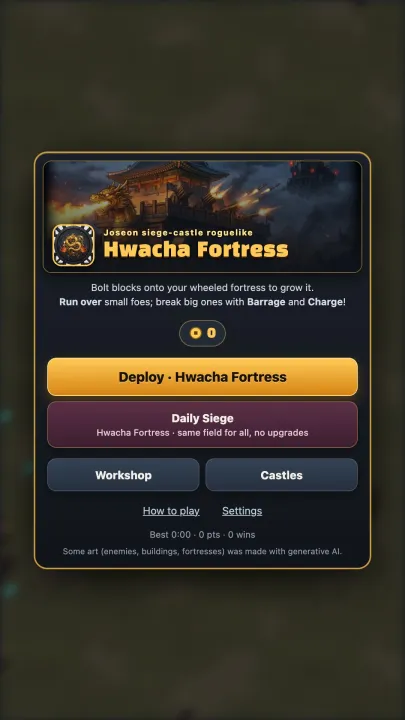
Now the game. The beacon in Hwacha Fortress is a difficulty ladder. Each clear unlocks the next beacon, enemies get tougher, and you earn more coins. The game runs from Beacon 0 to Beacon 5, six levels in total.
| Level | Rule added (cumulative) | Coin multiplier |
|---|---|---|
| Beacon 0 | Base game | x1.0 |
| Beacon 1 | Enemy HP +40% | x1.25 |
| Beacon 2 | Enemy damage +50% | x1.5 |
| Beacon 3 | 15% of normal enemies become elites; enemy HP +65%, damage +90% | x1.75 |
| Beacon 4 | Boss HP +60%, boss summon interval -30% | x2.0 |
| Beacon 5 | Auto-repair and repair drops cut to 30%; enemy HP +60%, damage +110%, boss HP +80% | x2.5 |
Compared with the historical system:
| Real bongsu | Hwacha Fortress | |
|---|---|---|
| Levels | 1 to 5 signals | Beacon 0 to 5 |
| Higher means | A more urgent threat | A harder run |
| Who raises it | The tower soldiers | You, by clearing the level below |
| Reward | None, it is a warning | Bigger coin multiplier |
The similar count is a coincidence. The game does not reproduce the five-signal code. Unlocking Beacon 1 depends on one thing, and the game says so: "Destroy the Imperial Colossus to unlock Beacon 1". After that the hint reads "Clear Beacon {n} to unlock the next beacon".
Beacon progress is shared across castles, not per castle. Whichever castle you used to clear a level, the next level is open to all. The achievements "First Beacon", "Third Beacon" and "Fifth Beacon" come from clearing Beacons 1, 3 and 5.
Picking a beacon in practice
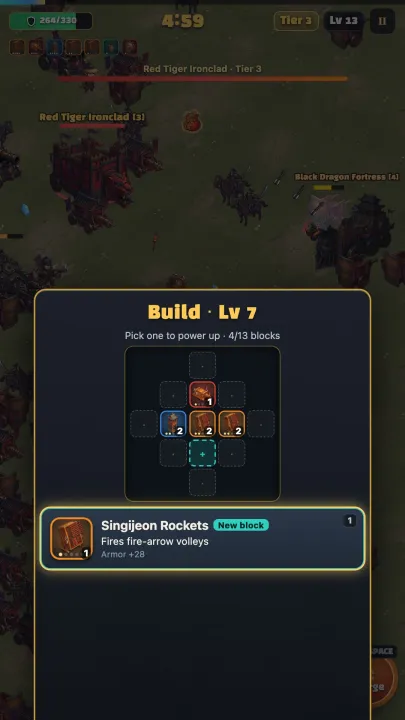
- Beacons 1 and 2 are number changes. Only enemy HP or damage goes up, so your normal build still works.
- Elites arrive at Beacon 3. Gold-rimmed enemies have four times the HP, so thin them with Barrage before you ram into them.
- Beacon 4 is about bosses. They are tougher and arrive more often. Save your tier-up repairs for them.
- Beacon 5 has almost no healing. Look for routes where you take no damage rather than rushing in.
- Higher levels pay more coins, but the highest beacon you can actually clear earns more than repeating one you keep losing.
The Daily Siege is the same battlefield for everyone on a given date. The date picks one of Beacon 0, 1 or 2, and the title screen shows "Today's beacon n".
Try it on the web: Hwacha Fortress.
Summary
- Bongsu was a relay of daytime smoke and night fire that carried news to Mongmyeoksan (Namsan) in Hanyang.
- One signal meant peace; two, three, four and five meant enemy sighted, approaching, crossing, and fighting.
- In rain or fog, soldiers are said to have run the message by foot.
- The beacon levels in Hwacha Fortress are our own difficulty ladder, Beacon 0 to 5, not a copy of the five-signal code.
- Beacon 1 opens after you defeat the final boss, and the progress is shared across castles.
Written by the JWorld team from our game design documents and measured play data, with AI tools helping with the writing.