A side-by-side look at chess and janggi (Korean chess), the rules that trip up chess players, and opening tips for each AI opponent on the Hanpan ladder.
If you play chess, janggi will feel half familiar. There is a general, there are chariots, and you win by cornering the enemy general. Then you sit down for a game and get tangled within minutes. Pieces stand on the points where lines cross, not on squares. Cannons only move by jumping over something. And your general is locked inside a tiny palace.
This guide comes from the JWorld team, who make Hanpan Gomoku & Janggi. It uses the rules text and opponent notes inside the game to show where chess players should be careful.
Chess vs. janggi at a glance
| Chess | Janggi | |
|---|---|---|
| Board | 8×8 squares | 9 files × 10 ranks, played on the crossing points |
| Pieces per side | 16 | 16 |
| The king's area | The whole board | Only the 3×3 palace |
| Who moves first | White | Cho (green) |
| Starting layout | Fixed | You choose how horses and elephants are placed (the "setup") |
| Passing | Not allowed | You may pass once in a while |
| Winning | Checkmate | Checkmate, or a points decision |
Each janggi side has 1 general, 2 guards, 2 elephants, 2 horses, 2 chariots, 2 cannons and 5 soldiers. That is 16 pieces, the same count as chess but a very different mix.
How the pieces move
This follows the "How to play Janggi" screen in the game.
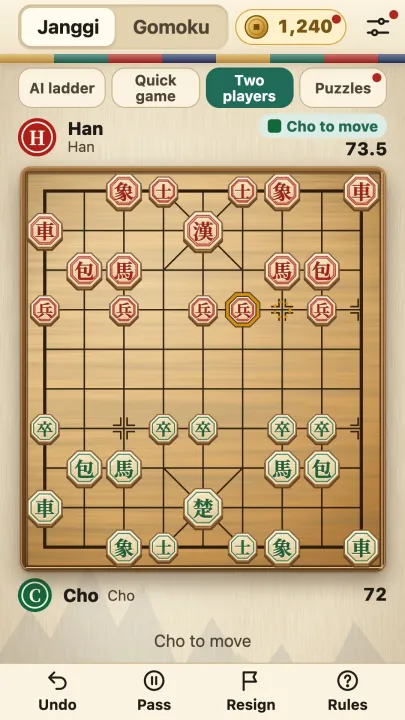
- Chariot: slides straight any distance, like a rook. Inside a palace it can also follow the diagonal lines.
- Cannon: moves or captures by jumping over exactly one piece. The piece it jumps cannot be another cannon, and a cannon cannot capture a cannon. Chess has nothing like this, so it is the strangest piece at first.
- Horse: one point straight, then one diagonal. It looks like a knight, but if the first straight point is occupied, the horse cannot go.
- Elephant: one point straight, then two diagonal. If either point on the path is blocked, it cannot go.
- General and guard: one point at a time inside the palace, and diagonally only where the palace has a diagonal line.
- Soldier: one point forward or sideways, never back. Inside the enemy palace it gains the forward diagonals.
The most common mistake from chess players is blocking. A chess knight jumps over everything. A janggi horse or elephant is stopped by a piece on its first step.
Pieces have point values
Janggi games can end on points, so you should know the table.
| Piece | Points |
|---|---|
| Chariot | 13 |
| Cannon | 7 |
| Horse | 5 |
| Elephant | 3 |
| Guard | 3 |
| Soldier | 2 |
Each side starts with 72. Han, who moves second, gets 1.5 bonus points, so Han counts as 73.5. That is why there are no draws. Keep the table in mind when trading. One chariot (13) is worth more than a horse and an elephant together (8). Do not carry over the chess habit of treating a bishop and a knight as equals.
The palace and bikjang
Both palaces have diagonal lines drawn in. Chariots and cannons can travel along them, which makes the palace more dangerous than the area in front of a chess king. If an enemy chariot reaches a palace diagonal, thicken your guard cover.
When the two generals face each other on the same file with nothing between them, that is bikjang. Making bikjang is a legal move. With "Bikjang on", the side to move can only do one of two things:
- Break it by putting a piece in between, or by moving the general.
- Press Accept bikjang. The game is then decided on points straight away.
So if you lead on points, bikjang is a clean way to finish. If you trail, break it whenever your opponent creates it. You can switch between "Bikjang on" and "No bikjang" in settings. Start with it on.
Setups: choosing the opening layout
Chess has a fixed start. In janggi you choose the order of horses and elephants. The game names the four setups like this:
| Name | Order |
|---|---|
| Inner elephants | H-E-E-H |
| Outer elephants | E-H-H-E |
| H-E-H-E | H-E-H-E |
| E-H-E-H | E-H-E-H |
Han chooses first and Cho chooses second, and Cho still moves first. Cho gets to see the opponent's choice, which balances things out. Beginners often find inner elephants easy to defend with, since the horses sit near the palace. After a game or two, try the other setups. In the game, the AI at levels 1 to 4 picks a random setup, while levels 5 to 10 answer yours with a prepared response.
Passing and checkmate
Pass skips your turn. The rules are short:
- You cannot pass while in check.
- If both sides pass in a row, the game goes to a points decision.
- At the move limit (100, 150, 200 or none; 200 is the default), or when a position repeats, the higher score wins.
Checkmate means a check that cannot be escaped. Because you cannot make a move that leaves your own general in check, capturing the general never actually happens. The feeling is the same as chess checkmate.
Opening tips against the ladder
The Hanpan ladder has 10 janggi opponents. The level screen shows a one-line note about each. Here are the ones most useful for a chess player.
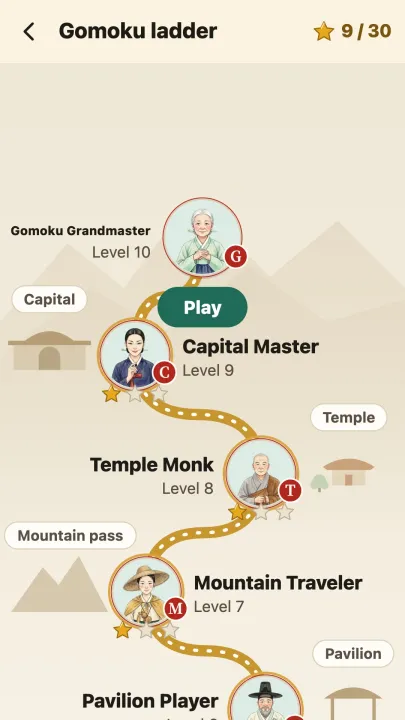
| Level | Opponent | Tip |
|---|---|---|
| 1 | Neighborhood Kid | Moves at random. Bring a chariot out and pick up free pieces first. |
| 2 | Alley Brother | Takes what is in front without looking further. Hide a chariot or cannon behind a bait piece. |
| 3 | Parlor Uncle | Loves cannons. Remove the piece a cannon jumps over and it loses its power. |
| 5 | Pavilion Elder | Guards the palace tightly. Keep your chariots and shake the palace front with horses and elephants. |
| 7 | County Magistrate | Reads checks to the end. Wall your general with guards and bring your chariots up slowly. |
| 8 | Bandit Chief | Plays for bikjang and points. When you lead on points, never let the generals face each other. |
| 10 | Janggi Grandmaster | Has prepared lines for every setup. Use your first ten moves to develop pieces evenly. |
Three habits carry across every level. Open your chariots early. Tidy the guards inside the palace first. And count piece values before you trade, because one trade can decide a game that ends on points.
When you are stuck: hints and undo
You get a limited number of Undo and Hint uses per game. Star goals such as "Win without undo" or "Win without hints" exist, so spend them freely on practice games and save them for star runs. A hint draws an arrow from a piece to its destination, and for captures it rings the piece that will be taken. There is also a Daily puzzle where you practice "checkmate within n moves". Only puzzles that the computer verified to have a single solution are included.
Summary
- Janggi is played on crossing points, and the general stays inside the 3×3 palace.
- Horses and elephants are blocked when the first step is occupied. They cannot jump like a chess knight.
- A cannon must jump exactly one piece, and cannons cannot jump or capture cannons.
- Values: chariot 13, cannon 7, horse 5, elephant 3, guard 3, soldier 2. Han gets 1.5 bonus points.
- Bikjang is either broken or accepted, and accepting it ends the game on points.
- Han picks a setup first, Cho second, and Cho moves first.
- Use the weaknesses of levels 1 to 3 (no look-ahead, cannon dependence) to find your feel for the game.
Play Hanpan on the web and start the ladder from the Janggi tab. The overview page is at /en/apps/hanpan/.
Written by the JWorld team from our game design documents and measured play data, with AI tools helping with the writing.