What jangseung posts were in Korean villages, how the five elements (wood, fire, earth, metal, water) work, and how Jangseung Guard turns them into game rules.
Jangseung Guard is a defense game in which one village totem holds off yokai coming from every side. Along the bottom of the screen sit five element charms, and if you switch the totem to the element that overcomes the incoming wave, your damage doubles. This article has two halves. First, what real jangseung and the five elements were. Then, how the game turns them into rules. We keep history and our own invention clearly apart.
What a jangseung was
A jangseung is a wooden or stone post set up at a village entrance, beside a road, or at a temple gate. The face is usually carved fierce and a bit comic, and the body often carries an inscription. Two roles are commonly described.
| Role | What it meant |
|---|---|
| Village guardian | Believed to keep bad luck, epidemics and wandering spirits out of the village |
| Marker | Marked the edge of a village, and along roads is said to have worked as a rough distance marker too |
The inscriptions most often read "Cheonha Daejanggun" and "Jiha Yeojanggun": the Great General under Heaven and the Lady General under Earth. The classic picture is a pair standing on either side of the entrance. Names and shapes vary by region. Some places on the southern coast call them "beoksu", for example. There was never one standard design, and that variety is the point.
Another village-entrance object is the sotdae, a tall pole topped with a carved bird. It is not a jangseung, but it belongs to the same family of customs about protecting a village and wishing for good fortune.
The five elements: two cycles
The five elements, or ohaeng, are an old East Asian way of describing the world through wood, fire, earth, metal and water, and how they act on each other. Everything rests on two cycles.
| Cycle | Order | Meaning |
|---|---|---|
| Generating (sangsaeng) | wood → fire → earth → metal → water → wood | Each feeds the next: wood feeds fire, fire leaves ash (earth) |
| Overcoming (sanggeuk) | wood → earth → water → fire → metal → wood | Each restrains the next: roots break earth, earth dams water |
The elements also map to colors and directions. The widely cited pairing:
| Element | Traditional color | Direction |
|---|---|---|
| Wood | blue-green | east |
| Fire | red | south |
| Earth | yellow | center |
| Metal | white | west |
| Water | black | north |
These five colors (obangsaek) show up across Korean tradition: the striped sleeves of children's hanbok, the painted patterns on palace and temple eaves, small charm pouches. Exact interpretations differ between sources, so treat the table as the common version.
What the totem does in the game
From here on it is our design. No record says a real jangseung hurled elements at monsters. We took the image of a post guarding a village and the overcoming cycle, and joined them in one rule.
The rule is short.
- Every attack the totem makes uses its current element.
- If that element overcomes the enemy's, damage is ×2. If it is the reverse, ×0.5.
- Labels at the top show the current and next wave: "Now: Wood yokai", "Next: Metal yokai → use Fire".
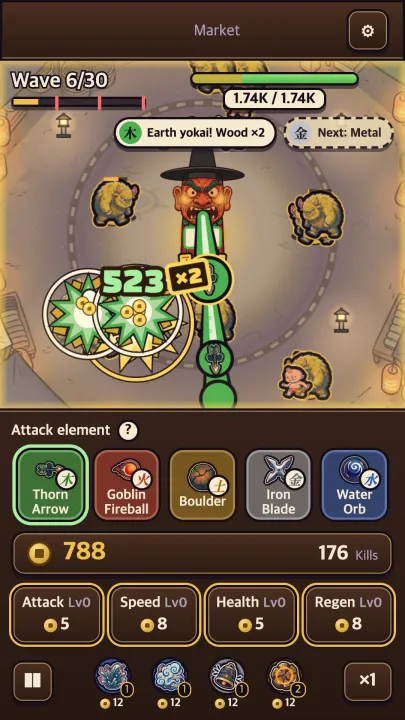
In that screenshot the next wave is Metal. Fire melts metal, so the Fire charm carries the ×2 badge. Tap it and your weapon becomes the Goblin Fireball, hitting for double.
Each element has its own weapon.
| Element | Weapon | Behavior |
|---|---|---|
| Wood | Thorn Arrow | Pierces several yokai in a line |
| Fire | Goblin Fireball | Bursts on hit and burns the area around it |
| Earth | Boulder | Slow, hits hard and knocks back |
| Metal | Iron Blade | Thrown very quickly in a stream |
| Water | Water Orb | Bounces to a neighbor and slows |
One honest note: the charm colors do not copy the traditional five. Water is blue rather than black, metal is silver-gray rather than white. We chose them so the five buttons stay easy to tell apart on a small screen.
The generating cycle powers your skills
If overcoming is for switching elements, generating is for picking skills. After each wave you choose one of three skill cards. Read the small print on a card and you will see a line like this:
Water skill · +25% while the totem is Wood
Water feeds wood, so a water skill gets +25% while the totem is Wood. A metal skill feeds water, so it says "+25% while the totem is Water".
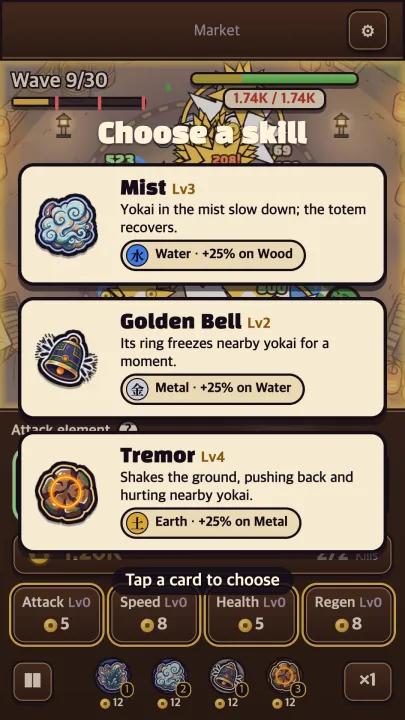
That gives you two separate habits. Overcoming asks "what is the next wave, and which element beats it?" Generating asks "which element am I usually standing on, and which skills fit it?" Picking the same skill again raises its level, and at Lv5 it awakens. With ten skills in total, two per element, piling everything onto one element is tempting, but the overcoming switches will keep moving your totem around, so watch the balance as you pick.
Five guardians and the relics
The game has five totems, unlocked by meeting conditions. Names and elements:
| Totem | Element | Trait |
|---|---|---|
| Great General | Wood | The starter. Evenly strong |
| Lady General | Water | The General's partner. High health and regen |
| Stone Guardian | Earth | Slow, but starts with the Quake skill |
| Sotdae | Metal | Reads the next wave and switches element for you |
| Beoksu | Fire | Collects more coins |
The real names above became the game's totems. The sotdae is not a jangseung in real life; making it a bird that switches your element automatically is our own interpretation.
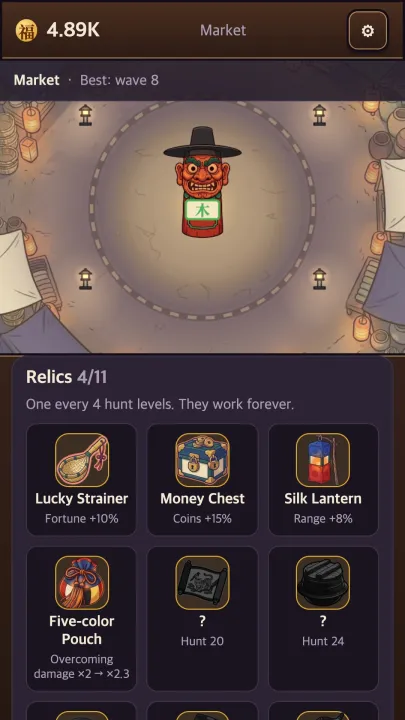
The relics you earn from the Yokai Hunt borrow from everyday objects: Lucky Strainer, Money Chest, Silk Lantern, Five-color Pouch, Tiger & Magpie, Iron Cauldron, Herb Pot, Shield Kite, Horn Bow, Moon Jar and Yut Sticks, eleven in all. The Five-color Pouch echoes the small charm bag sewn from the five traditional colors, and in the game it makes overcoming stronger: "Overcoming damage ×2 → ×2.3". One relic comes every 4 hunt levels, and they work forever.
Summary
- A jangseung is a wooden or stone guardian post at a village entrance. The pair of Great General and Lady General is the classic form, and names and shapes varied by region.
- The five elements are two cycles among wood, fire, earth, metal and water: generating (feeding) and overcoming (restraining).
- In the game, overcoming drives element switching (×2, or ×0.5 if reversed) and generating gives skills +25%.
- Charm colors differ a little from the traditional five colors, chosen for readability.
- Totem and relic names come from tradition; what they do is game design.
You can try it at Jangseung Guard. In your first run, watch the "Next" label and tap the charm with the ×2 badge.
Written by the JWorld team from our game design documents and measured play data, with AI tools helping with the writing.