The same five-in-a-row game plays differently under different rules. Learn what each of the three rule sets forbids, how to spot 3-3, 4-4 and overlines, and how to practice with the daily puzzle.
Have you ever been mid-game when a friend says "you can't play there, that's a double three"? Gomoku looks simple: line up five stones across, down or diagonally before your opponent does. But which rules you use decides whether a given move is a winner, a legal move or a foul.
This guide comes from the JWorld team, who make Hanpan Gomoku & Janggi. It walks through the three rule sets built into the game, explains the forbidden-move terms, and suggests how to practice. Names and wording follow what you see on screen.
The basics
Here is the board in Hanpan.
- It is a 15×15 grid of crossing points. Stones go on the intersections, not inside squares.
- Black moves first, then players alternate one stone at a time.
- The first to line up five stones across, down or diagonally wins.
- If all 225 points fill up, the game is a draw.
- Coordinates run A to O across and 1 to 15 up. The center point is H8.
Tap Rules at the bottom of the screen to open "How to play Gomoku". It repeats these basics and explains the forbidden ✕ marks.
The three rule sets at a glance
You pick the rule in settings. The default is No 3-3.
| Rule | Forbidden points | What wins |
|---|---|---|
| Free | None | Five or more for either color (six or more also wins) |
| No 3-3 (default) | 3-3 for both colors | Exactly five for either color. 4-4 and overlines are allowed |
| Renju | 3-3, 4-4 and overlines for Black only | Black needs exactly five. White wins with five or more |
The in-game descriptions say the same thing. Free reads "No forbidden moves. Five or more in a row wins." Renju reads "Only Black is barred from 3-3, 4-4 and overlines. White wins with six too. First stone in the center." No 3-3 adds a warning: "Some apps bar Black only." In other words, the same name can mean slightly different things on different services, so check before you mix apps.
Why forbidden moves exist
Black plays first, and that is a real advantage. Under free rules, the first-move edge is generally said to be large, so rule sets were made to take the strongest shapes away from Black. No 3-3 and Renju are examples. We saw the same effect in our own testing: the design notes for the AI ladder say that at higher levels Black's edge grows, so the team checks how often the AI wins when playing White, separately.
3-3, 4-4 and overline
The rules screen defines them like this:
- 3-3: one stone makes two open threes at once.
- 4-4: one stone makes two fours at once.
- Overline: six or more in a row.
An "open three" is a line of three that one more stone can turn into an open four, with both ends free. A "four" is a line that one more stone turns into five.
Three things to remember:
- A move that makes five is never forbidden. The game says so: "A point that makes five is never forbidden." Even if the same stone also creates a 3-3 or 4-4, making exactly five wins.
- A split 4-4 still counts. Two stones, a gap, two stones: filling the gap makes a four, and it counts as a four inside a single line.
- A 3-3 can be fake. If only one of the two threes can actually become an open four, the point is not forbidden. And if the extension point is itself forbidden, that three cannot be made. The game checks this recursively before drawing a ✕.
Reading the ✕ marks
Points you cannot play show a ✕ on the board, and tapping them does nothing. Under the official rules, playing a forbidden move loses the game. Hanpan is kinder: it blocks the move so you cannot lose by accident. If you try anyway, a message tells you which one it is: "Forbidden point: double three", "Forbidden point: double four" or "Forbidden point: overline".
Turn off Show forbidden ✕ in settings and only the marks disappear. The blocking stays. Once you know the rules well, hiding the marks is good practice for spotting them yourself.
The Renju first move
Pick Renju and Black's first stone is fixed at H8, the center. Tap elsewhere and you see "Under Renju the first stone goes in the center (H8)". Full tournament Renju has extra opening rules. According to the design notes, Hanpan leaves those out, so treat this as Renju-style play, not a tournament rule set.
Which rule should you pick?
| If you... | Try |
|---|---|
| are learning and want the simplest rules | Free |
| feel Black wins too easily, or want a fairer game with a friend | No 3-3 |
| want something closer to formal play | Renju |
The AI ladder uses the rule you chose (default No 3-3), so the same opponent can feel different after you switch.
Practice with the daily puzzle
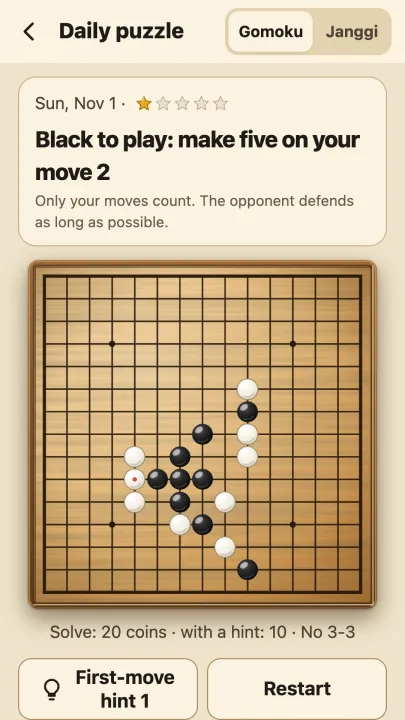
Once the rules make sense, practice. Tap Puzzles at the top to open the Daily puzzle. A Gomoku puzzle reads something like "Black to play: make five on your move 2".
- There are 120 Gomoku puzzles and 120 Janggi puzzles, rated from one to five stars.
- According to the design notes, only puzzles with a single correct winning line were kept, so you will not run into "wait, this other move works too" disputes.
- Only your moves count. The opponent defends for as long as possible.
- Wrong? Restart as many times as you like.
- First-move hint can be used once. In the screenshot, solving paid 20 coins and solving with a hint paid 10.
- Solving either the Gomoku or the Janggi puzzle counts toward your daily streak.
The line under the board shows which rule applies. This one is No 3-3.
Settle rule arguments in Two players
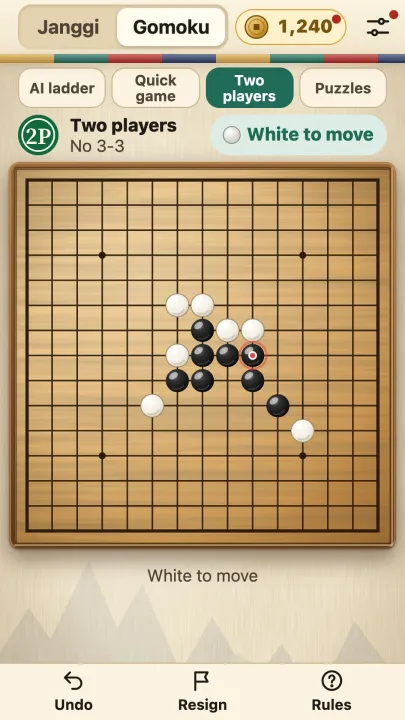
On one device with a friend, Two players shows the current rule at the top. The screen below is No 3-3 with White to move. If a disagreement starts, trust the label and the ✕ marks.
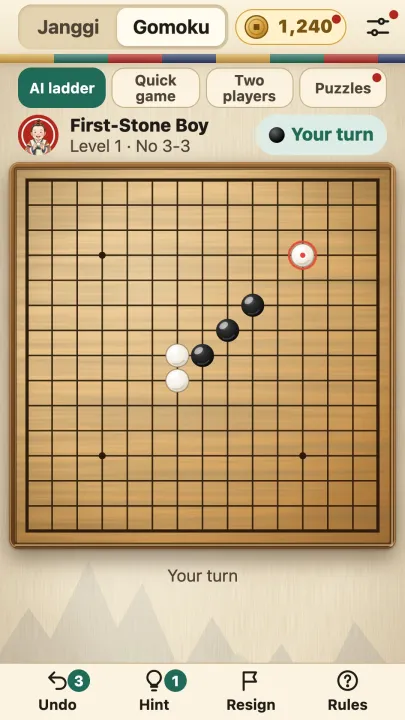
Beginners get a little help too. On AI ladder levels 1 and 2, and in Two players, a red circle appears on a point where the opponent would make five next turn if you do not block. The first time it shows, a note says "Red circles mark where you must block". If you can make five yourself right now, no circle appears, because winning comes first.
Learning the rules against the AI
The AI ladder has ten levels. Level 1 is First-Stone Boy and level 10 is Gomoku Grandmaster. The low levels often miss open threes, which makes them good partners for practicing shapes like 3-3. If you get stuck, tap Hint and a translucent stone shows the suggested move. In the screenshot above there were 3 undos and 1 hint available.
Summary
- Gomoku is played on a 15×15 grid, Black moves first, and five in a row wins, but the forbidden moves depend on the rule.
- Free: no forbidden moves, five or more wins.
- No 3-3 (default): 3-3 is forbidden for both colors, exactly five wins.
- Renju: only Black is barred from 3-3, 4-4 and overlines, and the first stone is H8. White wins with six too.
- A move that makes five is never forbidden.
- Forbidden points show as ✕ and cannot be played.
- Practice with the daily puzzle: "make five in N moves".
Want to try it? Open Hanpan on the web and switch rules in settings.
Written by the JWorld team from our game design documents and measured play data, with AI tools helping with the writing.