Stall milestones, recipes, the night combo, how each regular arrives, the rumor formula and the five towns, using the labels the game shows.
Dokkaebi Tavern is an idle game about a little tavern beside a night road. You sell Rice Tea, hire helpers, and at night you serve yokai guests who place orders. Early on you just keep tapping Buy. A little later a real question shows up: "Is it time to move yet?"
The JWorld team wrote this guide from the game's own data and text. We cover stall milestones, recipes, night service, the Regulars collection, the rumor formula and the five towns. Everything here describes the version that is live today.
The daily rhythm: four minutes of day, two of night
A day in the tavern is four minutes of daylight and two minutes of night. The top bar shows what is left, such as "Day 3:35" or "Night 2:25". The clock only runs while the game is open.
At night, six yokai guests visit by default. Each one shows a speech bubble with a dish. If you serve that dish within 15 seconds, you are paid 25 seconds' worth of your current automatic income. A guest who orders an expensive dish is worth catching.
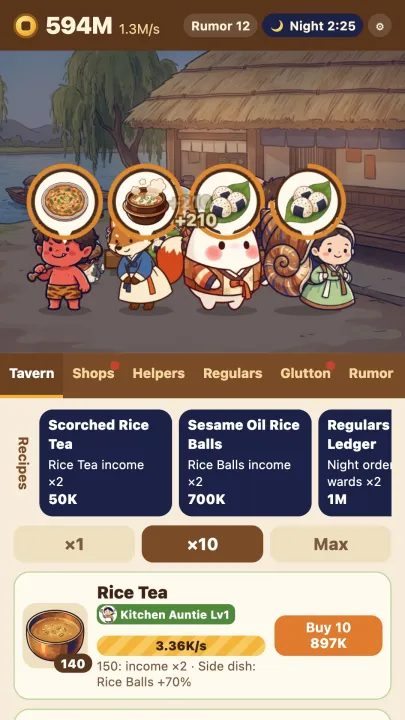
Serving guests back to back pays more. The game calls this Combo. Each order you serve without a miss adds +25% to the reward, up to 8 steps (×3). One missed order and the combo starts over, so look at the screen once more during the night.
| Item | Value |
|---|---|
| Day / night length | 4 min / 2 min |
| Base night orders | 6 guests |
| Time a guest waits | 15 s |
| Order reward | 25 s of automatic income |
| Combo | +25% per order, max 8 steps |
Stalls and milestones: how many of one dish to buy
There are ten dishes. They open in this order: Rice Tea, Rice Balls, Scallion Pancake, Soup & Rice, Rice Cakes, Cinnamon Punch, Honey Cookies, Braised Ribs, Royal Hot Pot and Royal Table. Each extra stall costs a bit more than the last, and the step differs per dish: ×1.07 for Rice Tea, ×1.12 for Scallion Pancake, ×1.08 for Royal Table.
What matters most are the milestones. When the stalls of one dish reach a set count, a big bonus applies at once.
| Stalls of one dish | Bonus |
|---|---|
| 10, 25, 50, 100, 200 | Cooking time halved |
| 150, 250 | Income ×2 |
| 300, 400 | Income ×3 |
| 500 | Income ×4 |
| Every 100 after that | Income ×2 |
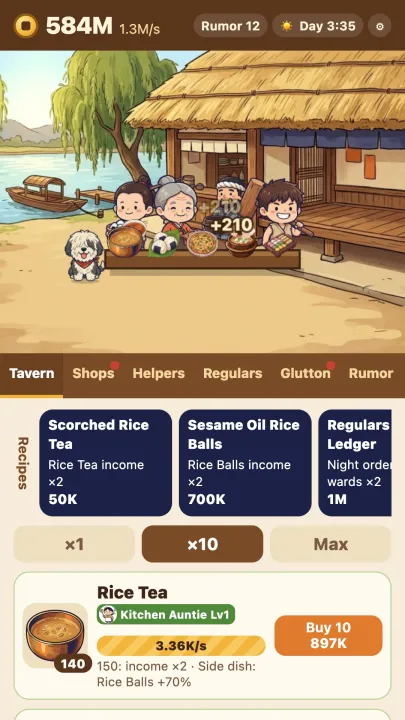
Each dish card shows its next milestone, for example "150: income ×2". You can buy with the ×1, ×10 and Max buttons. If a dish is only a few stalls short of a milestone, put your coins there first. Hopping to whichever dish is closest to its next milestone usually grows faster than pouring everything into one.
Recipes and helpers: what to buy first
At the top of the Tavern tab sits a row of Recipes. The screen shows cards like these:
- Scorched Rice Tea: Rice Tea income ×2
- Sesame Oil Rice Balls: Rice Balls income ×2
- Regulars Ledger: Night order rewards ×2
Buying a recipe once doubles that dish's income. The price is printed on the card, so check for an affordable recipe before you buy another stall. A recipe like Regulars Ledger only affects night orders, so it pays off most if you watch the night closely.
Each dish has one Helper: Kitchen Auntie for Rice Tea, the errand boy for Rice Balls, Pancake Granny for Scallion Pancake. Once hired, the dish cooks without tapping, even while you are away. When you come back you collect that income, capped at four hours by default.
Helpers level up with the hours they work, and they keep their levels when you move. At level 25 they become Skilled and at level 50 Master, which raises that dish's income further. The Teach button on the Helpers tab has a daily limit.
The Regulars collection: fixed conditions, no luck
There are 16 regulars. There is no randomness. When you meet a condition, the guest arrives, joins the collection and gives a permanent bonus. The first five order at night from the start. The rest start ordering after they visit.
| Regular | Arrives when | Bonus |
|---|---|---|
| Goblin Fire | Serve 3 night orders | Night is 30 s longer |
| Little Dokkaebi | 25 Scallion Pancake stalls | Scallion Pancake income ×3 |
| Egg Ghost | First move | +1 hour of away income |
| Fox | Serve 20 night orders | Night order rewards ×1.5 |
| Dueoksini | 50 Soup & Rice stalls | Soup & Rice income ×3 |
| Snail Maiden | 100 million coins earned in total | Helper prices -20% |
| Lucky Toad | 10 billion coins earned in total | All income ×1.5 |
| Haetae | 50 Rice Cake stalls | Rice Cakes income ×3 |
| Eoduksini | Serve 60 night orders | One more night guest |
| Jangseung | 50 Cinnamon Punch stalls | Cinnamon Punch income ×3 |
| Imugi | 100 trillion coins earned in total | Guests wait 5 s longer |
| House Serpent | 50 Honey Cookies stalls | Honey Cookies income ×3 |
| Jangsanbeom | Reach Hanyang Street | All income ×2 |
| Gumiho | Reach Dokkaebi Market | Night order rewards ×2 |
| Geuseundae | Hire all 10 helpers | All income ×2 |
That is 15 rows. The sixteenth, Bulgasari, arrives after your third move and raises the rumor you gain from moving by ×1.2.
The 50-stall conditions line up with the milestones. Buying 25 Scallion Pancake stalls brings Little Dokkaebi, and 50 Soup & Rice stalls bring Dueoksini. One purchase pays you twice, which makes it easy to decide what to buy next.
Each regular also has hearts (♥0 to 10). The more of their orders you serve, the higher it goes. Every heart adds +10% to that guest's order rewards and +1% to all income.
Rumor and moving: when to leave
When you move, coins, stalls and helpers reset. Rumor, regulars, achievements and the Rumor Shop stay. Each rumor point raises all income by +2%, and spending rumor in the shop does not lower that bonus.
Rumor follows the cube root of the coins you have earned: (total coins ÷ 1,000,000) to the power of 1/3. In numbers:
| Total coins earned | Rumor | Income bonus |
|---|---|---|
| 1 billion | 10 | +20% |
| 1 trillion | 100 | +200% |
| 1 quadrillion | 1,000 | +2,000% |
A thousand times more coins gives only ten times more rumor. To double your rumor you need eight times the coins. Move too often and each move gives little. Wait too long and income slows. The game helps: the Move screen says "Moving now gives +N rumor", and when a move would raise income by 30% or more it tells you "You can move now!". Use that prompt as your signal.
The first move is special. Once your first run has earned 1 billion coins, a move gives at least 15 rumor, which is +30% income forever. The in-game text reads "First move: +30% income". Egg Ghost also arrives with your first move and adds an hour to your away income, so we suggest not putting the first move off.
The five towns: what changes where
To move to a new town you need to earn a set amount of coins in a single run. Each town adds one more dish to sell and brings its own effect.
| Town | Coins needed (one run) | Dishes | Effect |
|---|---|---|---|
| Ferry Landing | Start | 6 | None |
| Market Town | 3 × 10^14 | 7 | All income ×1.5 |
| Mountain Pass | 1 × 10^24 | 8 | All income ×1.5, +1 night order |
| Hanyang Street | 2 × 10^28 | 9 | All income ×2, helper prices -30% |
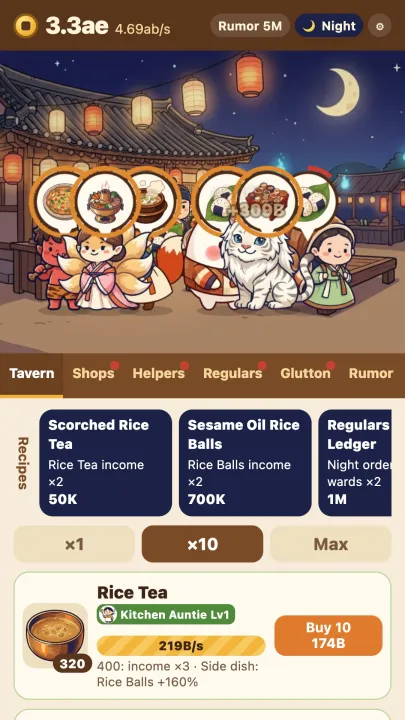
| Dokkaebi Market | 1.5 × 10^32 | 10 | All income ×2, always night, night order rewards ×2 |
Dokkaebi Market has only night. Night order rewards ×2 and the Combo pay off most there, so stock up on night-order recipes like Regulars Ledger before you arrive.
Summary
- Four minutes of day, two of night. Serve night orders within 15 seconds and chain them for up to ×3.
- Buy stalls of the dish that is closest to its milestone: 10, 25, 50, 100 and so on.
- A recipe doubles that dish's income. Check the cards before you buy another stall.
- Regulars arrive by fixed conditions, no luck: 25 Scallion Pancake stalls, 50 of Soup & Rice, Rice Cakes, Cinnamon Punch or Honey Cookies are the main ones.
- Rumor follows the cube root of coins, so doubling it takes eight times the coins. Move when the game says "You can move now!".
- The first move is at 1 billion coins and gives +30% income. Do not delay it.
To try it, open Dokkaebi Tavern on Playgama. The game's page is at /en/apps/jumak/.
Written by the JWorld team from our game design documents and measured play data, with AI tools helping with the writing.