A short look at the roadside taverns of Joseon Korea, what they served and who stopped there, with a clear line between real history and what Dokkaebi Tavern invents.
A jumak (酒幕) was a small roadside shop in Joseon-era Korea. The name literally points to drink, but these places also sold hot meals and often a spot to sleep. Dokkaebi Tavern, our idle game, is set in one. So before we built it, the JWorld team looked into what a jumak really was.
This article has two halves. First comes history. Then comes what the game invents. Each section says which one it is, so the two never blur together. Old records vary by source, so where we are not sure, we say "according to records" or "is said to".
A jumak sat where the road did
Taverns appeared where people walked past. Records suggest the classic spots were beside main roads, at river ferry landings, at the foot of mountain passes and near market towns. When most travel was on foot, how far you could get in a day was fixed, and wherever travelers needed a rest before dark, a jumak tended to appear.
The person running it was commonly called a jumo (酒母). She is said to have cooked the rice and soup, greeted guests and handed out rooms.
A jumak is not the same as a gaekju. A gaekju was, as the story is usually told, a larger merchant house that also stored and brokered traders' goods. A jumak was the small, plain version: a roadside stop for food, drink and sleep.
Dokkaebi Tavern borrows this idea of "the road" directly. Your first town is the Ferry Landing, and as you move on you pass through the Market Town, the pass road and Hanyang Street. All of those are places where a real tavern could plausibly have stood. Only the last stop, the Dokkaebi Market, is the game's own invention.
What did they serve?
The signature items were liquor and gukbap, rice served in hot soup. According to records, cloudy rice wine such as makgeolli and a bowl of soup with rice were common, because a single bowl suited a hurried traveler. Sungnyung is a toasty drink made by pouring water into the scorched rice left at the bottom of the pot and heating it, and it is widely known as the traditional drink at the end of a Korean meal.
Here is the real menu next to the game's menu.
| Game dish (English label) | Link to old taverns | Verdict |
|---|---|---|
| Rice Tea | The scorched-rice drink at the end of a meal | Old food |
| Rice Balls | An easy lump of rice to carry on the road | Plausible old food |
| Scallion Pancake | Pan-fried jeon belong to the traditional table | Old food |
| Soup & Rice | The tavern's signature bowl | Old food |
| Rice Cakes, Cinnamon Punch, Honey Cookies | Widely known as festival, holiday and snack foods | More feast than roadside |
| Braised Ribs | A feast dish | Feast |
| Royal Hot Pot, Royal Table | Court and banquet cooking | Far from a roadside tavern |
The first four are at home in a tavern. The last six were added so the idle-game ladder has somewhere to climb. The game has 10 dishes, and each one costs more and looks grander than the last. A royal hot pot on a ferry-landing counter is the game's imagination, not history.
There is no liquor in the game
Here is the biggest gap. A historical jumak was, at its core, a place that sold drink. Dokkaebi Tavern's menu has no alcohol. The design notes say it plainly: no liquor for now, a choice made so the game stays suitable for every age.
So the game's tavern is closer to a soup shop, a snack street and a rice-cake stall rolled together. Knowing that makes the history easier to enjoy, because you can see exactly where the game departs from it.
Travelers and the peddler
Who stopped at a jumak? According to records, traveling merchants called bobusang, scholars on their way to exams, runners for local offices and ordinary wanderers. A bobusang was a peddler who carried goods on their back from market to market.
Many travelers are said to have slept in one shared room. That made a room the place where road news and gossip changed hands, which is why people say a jumak collected the rumors of the road.
The game has a Peddler too. Sometimes one visits during the day, and tapping him gives you coins. The in-game line reads "A peddler is here! Tap him for coins". That is a real historical figure turned into a bonus guest.
What Dokkaebi Tavern made up: night service and regulars
Everything from here on is invented by the game.
The game cycles through day and night.
| Item | Value |
|---|---|
| Day | 240 seconds (4 minutes) |
| Night | 120 seconds (2 minutes) |
| Base night guests | 6 |
| How long a guest waits | 15 seconds |
| Reward for serving in time | 25 seconds of your current income per second |
When night falls, yokai guests show an order in a speech bubble. Tap the matching dish within 15 seconds and you get the reward. A missed order costs you nothing.
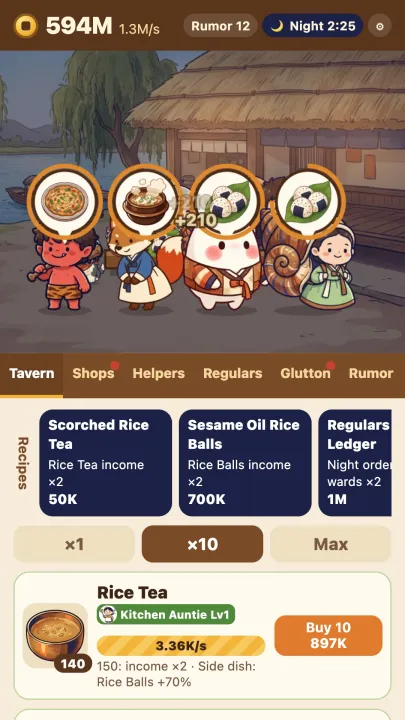
The guests are the same yokai that fight in our other game, Dokkaebi Night. The Regulars tab holds 16 of them, and each arrives when you meet its condition. There are no random rolls. Goblin Fire shows up after you serve 3 guests and lengthens the night by 30 seconds. Little Dokkaebi arrives when you own 25 Scallion Pancake stalls and triples that dish's income. Gumiho can be met in the Dokkaebi Market.
Making yokai into travelers is our own invention, but the names come from folk tradition. Haetae is known as a guardian against fire, and a jangseung as the post that guards a village entrance. The game borrows a little of that character for each.
Playing one run
Here is the opening.
- Buy Rice Tea first. It is the first and cheapest dish.
- When coins build up, unlock Rice Balls and Scallion Pancake.
- Hire Helpers so dishes cook without tapping. The Rice Tea helper is the Kitchen Auntie.
- When night comes, tap the speech bubbles to serve orders.
- When Rumor builds up, move. Each Rumor point gives +2% income. Moving resets your coins and stalls but keeps Rumor.
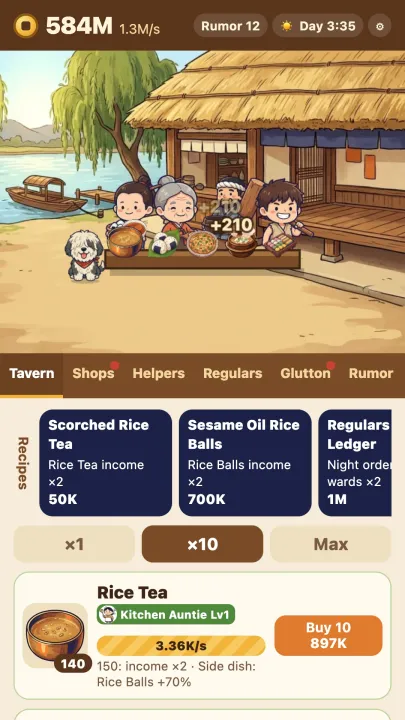
You work through five towns in order. You start at the Ferry Landing and finish at the Dokkaebi Market, which has only night and doubles night-order rewards. Hanyang Street cuts helper prices by 30%.
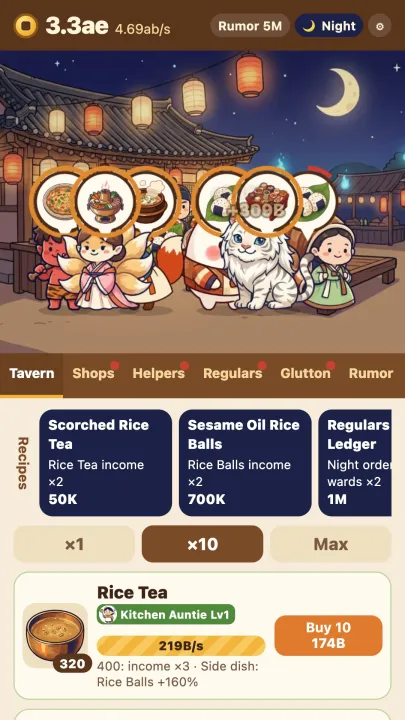
Income keeps building while you are away, but with a limit. The default is up to 4 hours, and you can extend it with ledgers from the Rumor shop.
You can read more on the Dokkaebi Tavern page, or open it in your browser at games.jworld.dev/en/jumak/.
Summary
- A jumak was a roadside shop at ferries, passes and markets that sold drink and soup rice and put travelers up for the night, as the records tell it.
- The proprietor was commonly called a jumo, and peddlers and wanderers stopped there often.
- Dokkaebi Tavern is an idle game that starts at the Ferry Landing, passes through five towns and has 10 dishes.
- A royal hot pot on the counter, 16 yokai regulars and the night orders are the game's inventions.
- There is no liquor in the game, so it stays suitable for all ages.
- The Peddler is a bonus guest borrowed from the historical traveling merchant.
Written by the JWorld team from our game design documents and measured play data, with AI tools helping with the writing.