A look at the Janggi board in Korean daily life, the phrases it left behind, and why the palace and bikjang rules look the way they do, with notes on how Hanpan Gomoku & Janggi carries that mood over.
A Janggi board is a familiar scene in Korea. Picture a village pavilion in the shade, a park bench, or the wooden floor of a senior center. Two people sit facing each other over one board, and a few onlookers stand behind them. You do not need to know the rules to picture it.
This article comes from the JWorld team, who make Hanpan Gomoku & Janggi. We kept what is widely known apart from what our game invents. Where we could not confirm a date or a record, we say "is said to" instead of stating it as fact.
The scene: pavilions, parks and parlors
Janggi needs very little. You need one board and 32 pieces, so it can be played almost anywhere. It is said to have settled in as an everyday pastime at village pavilions, in the parlors of houses, and at the edges of markets. Today you can still see older players set up a board in a park, and places like Tapgol Park in Seoul are often mentioned as one.
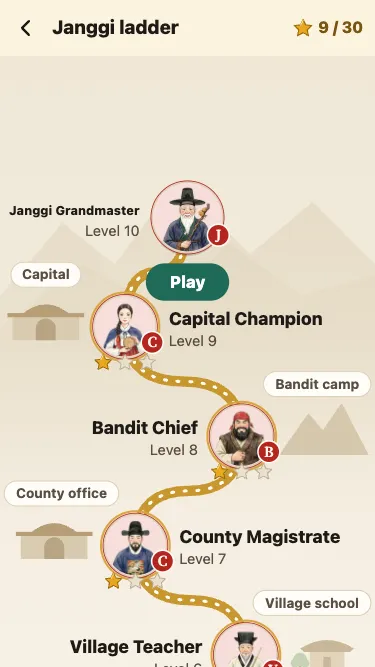
Hanpan carries that mood into its opponent names. The ten Janggi AI opponents are role names, not real people. This is what the game shows:
| Level | Opponent | One-line style |
|---|---|---|
| 1 | Neighborhood Kid | Moves pieces at random and misses captures |
| 2 | Alley Brother | Takes what is in front of him but ignores what is behind |
| 3 | Parlor Uncle | Looks two moves ahead and loves the cannon |
| 4 | Market Trader | Calculates every exchange |
| 5 | Pavilion Elder | Guards his palace tightly |
| 6 | Village Teacher | Reads deeper and rarely slips |
| 7 | County Magistrate | Makes no mistakes and reads checks to the end |
| 8 | Bandit Chief | Aims for bikjang and scoring |
| 9 | Capital Champion | Reads deep and trades well |
| 10 | Janggi Grandmaster | Arrives with prepared lines for every setup |
Read in order, it is a journey from the neighborhood to the pavilion, the village, the county and the capital. That ladder is our own story. It does not claim that Joseon society ranked players this way.
Cho and Han: why the two sides have these names
The two sides in Janggi are Cho (楚, Chu) and Han (漢). The names are said to come from the two states that fought for control of China in ancient times. You can see the characters on the two kings in the game: 楚 and 漢.
In the game:
- Cho is green and Han is red.
- Cho moves first.
- For the opening setup, Han chooses first and Cho chooses afterward.
Because the player who moves first gets to see the other side's setup before choosing, the order is balanced. This is the order the in-game rules screen uses.
Phrases the board left behind
Janggi also gave Korean some everyday expressions. These are commonly said to come from the board:
- "Jang-iya" / "Meonggun": When you threaten the opposing king, you call out "Jang-iya!" and the other side answers "Meonggun!" as they defend. The game marks this state as check.
- Hunsu: When a bystander leans in and tells a player what to do. There is a well-known saying that onlookers see the board better than the players. Players being annoyed by hunsu is a classic scene.
- "Let me take it back": Begging for one move back. The game has an Undo button, and in two-player mode undo is unlimited.
The game also reworks this scene a little. The hint button draws an arrow from a piece to a recommended square, so the app plays the role of the helpful onlooker. Some level star goals ask you to finish without hints, so you have to decide when to use it.
Palace rules: why the king stays in his room
The most distinctive part of a Janggi board is the palace at each end. It is a 3×3 set of points with diagonal lines, and the general and the guards (advisors) never leave it. A common way to explain this is that the king and his guards stay inside the palace. That reading is a teaching metaphor.
These are the palace rules the game implements:
| Piece | Movement in the palace |
|---|---|
| General (궁) | One step along the lines; diagonals only from points with a diagonal line |
| Guard (사) | Same as the general |
| Chariot (차) | Can move along the diagonals when standing on one |
| Cannon (포) | Jumps the piece at the center along a diagonal to the opposite corner |
| Soldier (졸·병) | Gains forward diagonals inside the enemy palace |
That is why palaces can look roomy and still be dangerous. When an enemy chariot reaches a palace diagonal, thicken your guards.
Bikjang and passing: the rules that end games
When the two generals face each other on the same file with no piece between them, it is bikjang. The game says "Bikjang: break it or accept it". With Bikjang on, the player to move has only two choices:
- Break it by placing a piece in between or by moving the general aside.
- Press Accept bikjang and let points decide the winner.
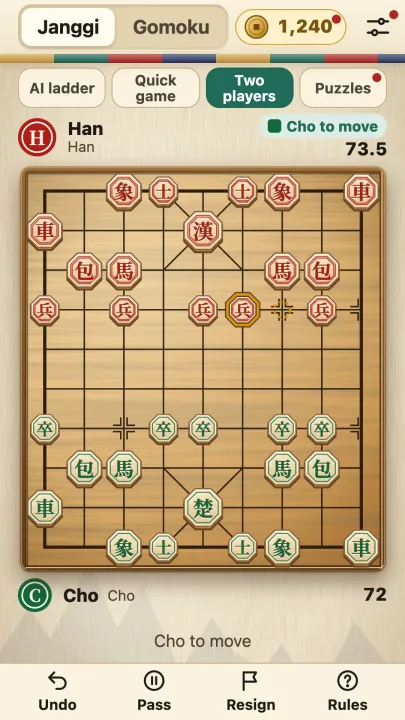
Pieces carry points: chariot 13, cannon 7, horse 5, elephant 3, guard 3, soldier 2. Each side starts with 72 points, and Han gets a 1.5 komi for 73.5. That is why the screen shows Han 73.5 and Cho 72, and why there are no draws. Scoring also happens when both sides Pass in a row. You cannot pass while in check.
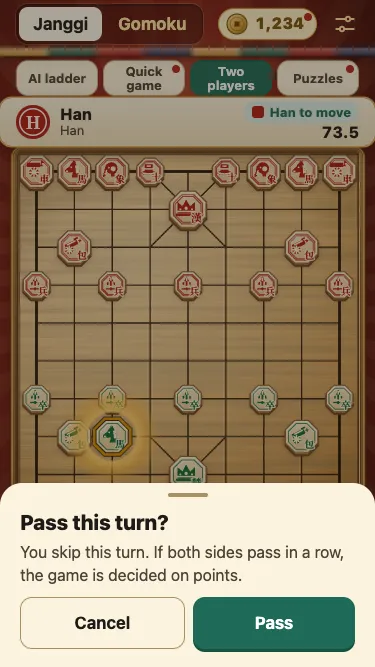
Bikjang customs are said to differ between places and tournaments, so the game lets you choose Bikjang on / No bikjang in settings. If your local rule is different, start there.
Playing it today
You do not need to reach the pavilion. The Janggi mode in Hanpan has:
- AI ladder: beat the ten levels above in order, and collect up to three stars each.
- Two players: sit face to face on one device, with unlimited undo, good for practice with family.
- Puzzles: one "mate in n" problem a day.
- Hangul piece labels: if Chinese characters are hard to read, you can switch pieces to Korean labels for free.
Play it in your browser: Hanpan Gomoku & Janggi
Summary
- Janggi is a street-level pastime: a board and pieces are all you need, in pavilions, parks and parlors.
- The side names Cho (楚) and Han (漢) are said to come from ancient Chinese states; in the game green Cho moves first.
- Phrases like "jang-iya", "meonggun", hunsu and "take it back" spread from the board into daily speech, and the game's check, hint and undo connect to them.
- The palace is a 3×3 zone with diagonals that the general and guards never leave.
- Bikjang and passing can lead to a points decision (chariot 13, cannon 7, horse 5, elephant 3, guard 3, soldier 2, Han komi 1.5).
- The ten AI opponents' names and ranking are our own invention.
Written by the JWorld team from our game design documents and measured play data, with AI tools helping with the writing.