How scoring works, which pieces show up most, what the Continue button does and how levels unlock themes, all taken from the rules of Block Daily.
Block Daily is a puzzle on an 8×8 board: place blocks, fill a whole row or column, and the line disappears. The rules fit in one breath, but the gap between a short game and a long one is large. The JWorld team wrote this guide from the game's code and in-game text, so the numbers match the version that is live today and the names are the ones you see on screen. You can play it in your browser.

The basic rules
- The board is 8×8, and you get three blocks at a time.
- When all three are placed, a new set of three arrives.
- Blocks cannot be rotated. You place them exactly as shown.
- A full row or a full column clears. A row and a column can clear at the same moment.
- If none of your remaining blocks fits anywhere, the game is over.
You can place the three blocks of a set in any order. That is the first habit worth building: look at all three before you touch one. No new blocks appear until the set is used up, so the best move is the one that makes the best picture out of what you can already see.
How scoring works
Your score has two parts.
- Placing a block gives you one point per cell of that block.
- Clearing lines gives you line points × your combo multiplier.
Line points grow quickly with the number of lines cleared in one move.
| Lines cleared at once | Line points |
|---|---|
| 1 | 10 |
| 2 | 30 |
| 3 | 60 |
| 4 | 100 |
| 5 | 150 |
Clearing two lines together gives 30, ten more than two separate single clears (10 + 10). Four lines give 100, not 40. So it often pays to wait until several lines are one block away from completion, instead of clearing each line the moment you can.
If a clear leaves the board completely empty, you also get a flat 300-point PERFECT! bonus.
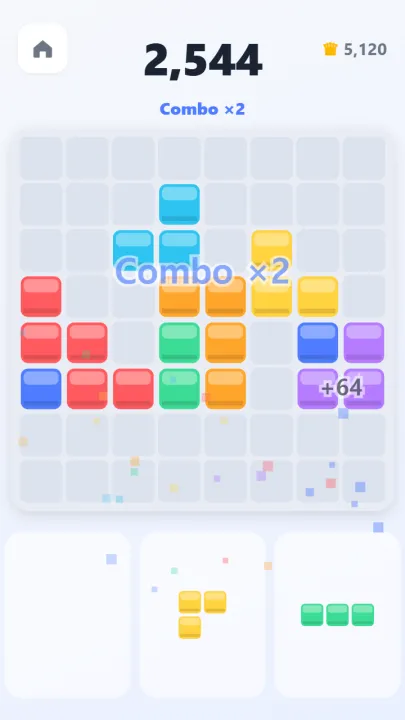
The screenshot below shows two lines clearing together. Combo ×2 doubled the 30 line points to 60, and the cells of the block you placed brought the total to +64.
Keeping a combo alive
Every time a placement clears at least one line, your combo goes up by one, and the combo number is the multiplier. At Combo ×3, clearing two lines is worth 30 × 3 = 90.
The combo resets to zero if you place three blocks in a row without clearing a line. A set has exactly three blocks, so placing a whole set without a single clear is enough to lose it. Prepare the board so that every set contains at least one clearing move and the combo never drops.
Some ways to use that:
- Inside a set, play the clearing block first or second, not last. If your plan goes wrong, you still have room to adjust.
- Save your big 3- or 4-line clears for when the combo is high. Four lines at Combo ×4 is 100 × 4 = 400 points.
Piece shapes and how often they appear
There are 15 base shapes, from a single cell to five cells. Counting every rotation as its own piece, the game has 37 different blocks. Each shape has a relative weight that decides how often it is dealt.
| Shape | Weight |
|---|---|
| 2×2 square | 1.3 |
| 2-cell bar, 3-cell bar | 1.2 each |
| Single dot, 4-cell bar | 1.0 each |
| Small corner (3 cells) | 1.0 |
| L, J and T pieces (4 cells) | 0.8 each |
| 5-cell bar | 0.7 |
| S, Z, 2×3 rectangle, 3×3 square | 0.6 each |
| Big corner (5 cells) | 0.5 |
Two things follow from this table.
- Small, compact pieces are the most common. The 2×2 and the short bars fill gaps well, so you will rarely be short of filler.
- The 3×3 square and the 5-cell bar are rarer but dangerous. Keep at least one row or column with five or more empty cells in a line, and the long bar always has a home. For the 3×3 you need one open zone.
Instead of filling the board evenly, it is safer to keep one side open and build from the other side, so big pieces still have somewhere to go.
Read the preview before you let go
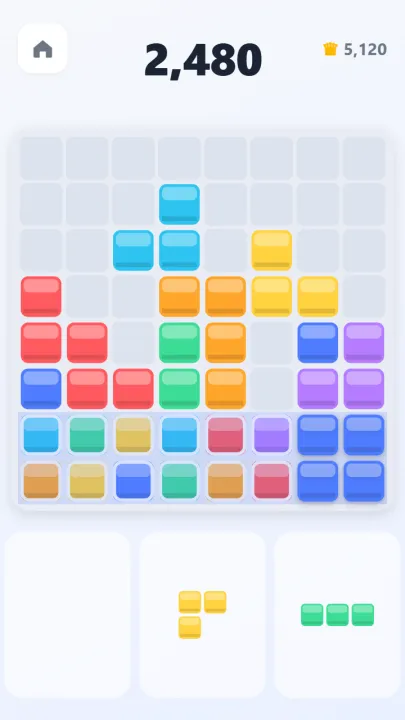
While you drag a block, the game shows where it can land and highlights the lines that would clear. In the screenshot, the two bottom rows are lit up, which means letting go right now clears both.
Check three things before you release:
- How many lines will clear. If it is only one, can you wait for a block that clears two?
- What holes you leave behind. A lone empty cell can only be filled by a single dot, which may take a long time to appear.
- Whether the other two blocks still have a place to go afterwards.
Classic and Daily Challenge are different
| Classic | Daily Challenge | |
|---|---|---|
| Block order | Random every game | Fixed by the date, same for everyone |
| Protection against unfair deaths | Yes | No |
| Continue | Once per game | Not available |
| Attempts | Unlimited | One per day |
| Records | Best score | Daily best and day streak |
In Classic, when a new set is dealt and none of its blocks fits on the board, the game re-deals (up to 30 tries). A set that is impossible from the first move is therefore very rare.
In the Daily Challenge, the date decides the block order, so everyone who plays that day gets the same sequence. The re-deal protection is switched off and there is no Continue. You can finish it once a day, and afterwards the card says a new challenge opens tomorrow. If you finish on consecutive days, the home screen shows a streak such as "6-day streak". Skip a day and it goes back to zero.
Because everyone gets the same puzzle, the Daily Challenge rewards patience. Look at all three blocks, decide the order, and in the empty early board do not rush for points: protect the space that large pieces will need.
Continue, levels and themes
When a Classic game ends, you can use Continue once per game. It clears the 3×3 area that is the fullest on the board and deals a new set. Where ads are available it appears as "Watch ad to continue".
Your level rises with the total number of lines you have cleared across all games. The first level-up takes 40 lines, and each later level needs 20 lines more than the one before.
| Level | Total lines | Theme unlocked |
|---|---|---|
| 1 | 0 | Classic |
| 2 | 40 | Candy |
| 3 | 100 | Ocean |
| 5 | 280 | Sunset |
| 7 | 540 | Neon |
Themes only change colors. Rules and scoring stay the same. You can pick one under "Block themes" on the home screen.
Summary
- The three blocks of a set can go in any order, so look at all three first.
- Clear lines together: 10 points for one line, 30 for two, 100 for four.
- A combo breaks after three placements without a clear, so aim for one clear per set.
- The 5-cell bar and the 3×3 square are rare but harsh. Keep one big open area.
- Classic softens unfair deaths; the Daily Challenge is one attempt a day on the same blocks for everyone.
- Levels come from total lines cleared, and themes unlock at levels 2, 3, 5 and 7.
Written by the JWorld team from our game design documents and measured play data, with AI tools helping with the writing.