What to buy in the shop, where your coins come from, what stardust unlocks and how the Daily Run differs, all using the labels you see in the game.
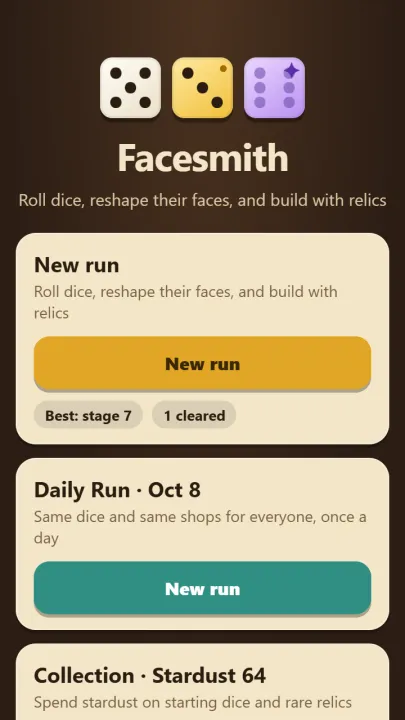
Facesmith is a roguelike where you roll dice and score with combos. There are 8 stages, and clearing a stage's target score opens the shop. The heart of the game is what you do there: swap the faces of your dice and buy relics until you have a build of your own.
The JWorld team wrote this guide from the game's data and in-game text. The numbers match the version that is live today, and the names are the ones the game shows. You can try it in your browser.
The basic loop
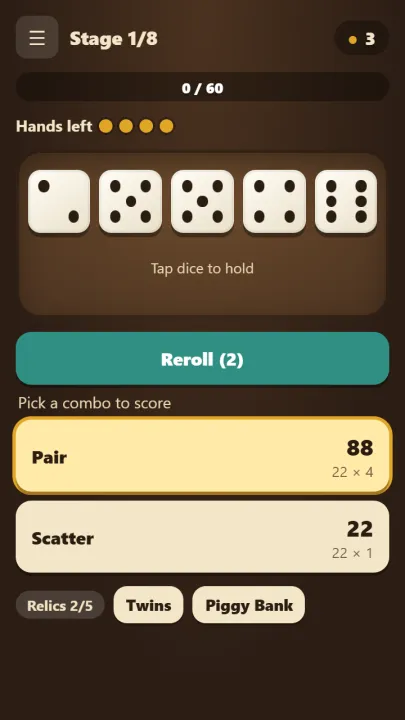
A run starts with five plain six-sided dice, five relic slots and 3 coins. Each stage gives you 4 hands, and each hand allows up to 2 rerolls.
- Roll the dice.
- Tap the dice you like to hold them. Only dice you do not hold are rerolled.
- Tap a combo in the list to score it.
The score is (pips + face bonuses) × combo multiplier. In the screenshot below, the pips add up to 22 and Pair is worth x4 because the Twins relic adds +2 to a base of x2, so the hand scores 88. You may cash any combo on the list, not only the best one.
| Combo | Base multiplier |
|---|---|
| Scatter | x1 |
| Pair | x2 |
| Two Pair | x3 |
| Triple | x4 |
| Small Straight | x5 |
| Full House | x6 |
| Four of a Kind | x8 |
| Large Straight | x10 |
| Five of a Kind | x15 |
The stage targets are 60, 120, 200, 330, 500, 730, 1,020 and 1,450. Stages 4 and 8 are boss stages that change one rule.
Repeating a combo lowers its multiplier
The game reminds you of this in a tip, and it shapes every decision. Each time you cash the same combo again in one stage, its multiplier drops one rung down the table. A second Pair is worth Scatter's x1. A second Triple is worth Two Pair's x3. Everything resets when the stage ends.
So hammering Pair every hand stops working quickly. Try this with your 4 hands:
- Chase your best combo on the first hand.
- On a hand that will not come together, cash a low combo you have not used yet.
- If the target is far away, rotate two or three different combos rather than repeating one.
Cashing a weak combo on purpose is allowed, and the repeat penalty is exactly why it needs to be.
What the shop sells: faces, relics and dice
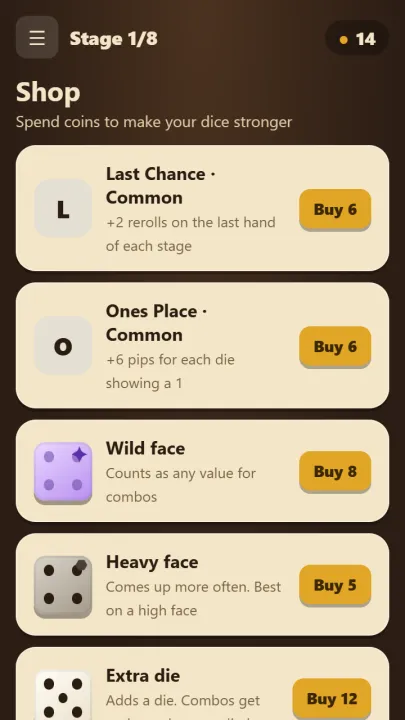
Clearing a stage opens the shop. You see two relics, two different special faces and one die (the die disappears once you own 7). The same seed always shows the same shop.
The 8 special faces
When you buy a face, the game asks you to pick the face to replace. The new face keeps the old face's pips (a Thorn is always 1). One die can hold several special faces.
| Face | Price | Effect (in-game text) |
|---|---|---|
| Gold | 3 | Earns coins when you score |
| Ice | 3 | Earns a reroll next hand when you score |
| Thorn | 3 | Always 1 pip, but +1 multiplier |
| Star | 3 | This face counts 1.5x its pips |
| Heavy | 5 | Comes up more often. Best on a high face |
| Blast | 5 | Rolled once more automatically when it comes up |
| Mirror | 7 | Copies the die to its right |
| Wild | 8 | Counts as any value for combos |
Two quick rules of thumb:
- Put Heavy on a high face. On a low face it makes low rolls more common, which hurts you.
- Star also likes high faces. The bigger the pips, the more the 1.5x is worth.
The 40 relics
You have 5 relic slots. Relics cost 6 (Common), 9 (Uncommon) or 12 (Rare) coins, and you cannot buy the same one twice. They fall into five groups: rerolls and hands, specific combos, specific values, coins and the shop, and risk with late-game scaling.
A few good ones to try first:
| Relic | Effect (in-game text) |
|---|---|
| Twins | Pair and Two Pair multiplier +2 |
| Six Lord | +2.5 pips for each die showing a 6 |
| Hourglass | +1 hand per stage, -1 reroll per hand |
| Patience | +1 multiplier per unused reroll |
| Snowball | +1 multiplier for each hand already cashed this stage |
| Piggy Bank | +1 coin each time you cash a triple or better |
| Haggler | Shop prices -15% |
Relics shine when they match your faces. If you collected Ice faces, pick something that rewards rerolls. If pairs keep showing up, Twins fits. The team once gave bots one free relic at a time to measure them, and Piggy Bank, Six Lord and Hourglass finished near the top. Treat that as a bot's view, though. The bots do not value coin effects, so relics built around Gold or Ice faces look weaker there than they may be in human hands.
Where coins come from
With too few coins, the shop is just a window. Here is the income:
| Income | Coins |
|---|---|
| Start of the run | 3 |
| Stage clear reward | 3 + the stage number (3 after stage 1, 4 after stage 2, and so on) |
| Each spare hand | 2 |
| Gold faces, Piggy Bank and similar | when you score |
And the spending: a shop Refresh starts at 2 coins and rises by 1 with each press. Extra dice cost 12 for the first and 17 for the second (up to 7 dice). A single die moves your score more than any one relic, so it is priced high on purpose.
- Finishing a stage early pays 2 coins for every hand you did not need.
- Refresh gets pricier, so use it once or twice at most.
- There is also a spot where watching an ad gives you a free refresh.
Boss stage rules
Stages 4 and 8 each change a rule. The run seed picks which one appears.
| Stage | Rule | What it does |
|---|---|---|
| 4 | Frozen opening | No rerolls on the first hand of this stage |
| 4 | Short fight | One fewer hand in this stage |
| 4 | Weak combos | Pair, Two Pair and Triple lose 1 multiplier |
| 8 | Cursed die | The first die always shows its lowest face |
| 8 | Just once | At most one reroll per hand |
| 8 | Forbidden combo | Scatter cannot be scored while another combo exists |
Weak combos is where a relic like Twins pays off, while Just once makes reroll relics less reliable. You cannot plan for stage 8's rule in the stage 4 shop, but a build that does not lean on a single trick is shaken the least by bosses.
Stardust and the Collection
Finishing a run earns stardust: stage reached × 2, plus 12 for a clear, plus 1 for every 150 points of score. For example, stopping at stage 5 with a total of 600 gives 10 + 4 = 14, and a clear adds 12 on top. Stardust is stored on this device only.
The Collection screen sells starting dice:
| Starting dice | Unlock | What it does |
|---|---|---|
| Plain Dice | free | Five ordinary six-sided dice |
| Gilded Dice | 30 | Three dice carry a gold face on the 1 |
| Frost Dice | 60 | Every die has an ice face on the 1 |
| Sixer Dice | 50 | Three dice have two 6s instead of a 1 |
| Wide Hand | 120 | Six dice, every face is 1 to 3, and you start with no coins |
Rare relics unlock for 30 stardust each, and they stay out of the shop until you do. For your first stardust, Gilded or Frost is a safe pick, because both are cheap and their purpose is clear. Wide Hand makes combos easy but keeps pips low, so try it after a few runs.
How the Daily Run differs
The Daily Run on the home screen uses the date as its seed, so everyone gets the same dice and the same shops. You get one per day, and afterward the game says a new run opens tomorrow.
- It always uses Plain Dice, whatever you picked in the Collection.
- Roll results depend only on the seed and roll order, so holding one die never changes what another die shows.
- A run in progress is saved, so you can close the tab and come back.
Because the run is identical for everyone, comparing what you bought in each shop is half the fun. Use Share result to copy your outcome for a friend. Regular runs start from New run.
Summary
- A run is 8 stages, 4 hands per stage and up to 2 rerolls per hand.
- Repeating a combo drops its multiplier one rung, so rotate combos.
- Put Heavy and Star on high faces, and buy coin effects early so they pay back longer.
- Relics are strongest when they match your faces. Rare ones need stardust to unlock.
- Coins come from clear rewards, spare hands (2 each) and Gold faces. Refresh starts at 2 and rises by 1.
- The Daily Run is the same for everyone, uses Plain Dice and happens once a day.
Written by the JWorld team from our game design documents and measured play data, with AI tools helping with the writing.