Three stars in Arrow Sweep don't come from tapping the arrow that clears the most. They come from an order that leaves nothing stranded. The sweep rule, each world's mechanic, and the Daily board explained.
In Arrow Sweep you tap an arrow and it slides off the board head first, shoving every arrow in its way off the board with it. Nothing ever bounces back and there are no hearts to lose. Every tap clears something. So the challenge is never whether you can clear a board, but how few taps it takes.
We made the game, so this guide uses the real rules and level design numbers to explain how to think about hitting par.
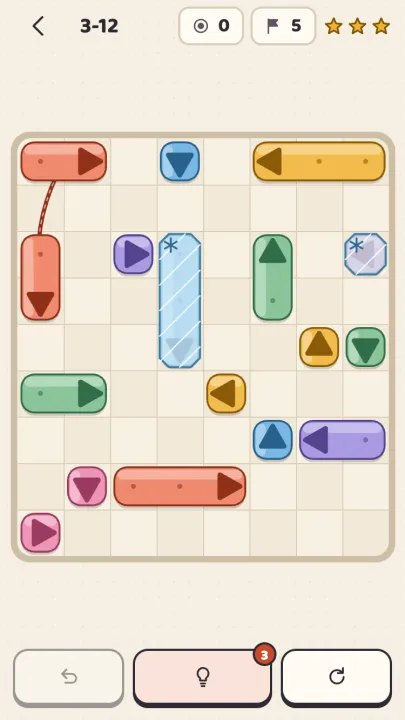
The three-star rule: Par
Every board shows a Par number at the top: the fewest taps that can clear it. Nobody guessed these numbers. A solver program checked every possible tap order to the end and found the true minimum, so par is always reachable.
| Stars | Requirement |
|---|---|
| 1 | Clear the board (always possible) |
| 2 | Par plus a margin (2 taps, or a quarter of par, whichever is larger) |
| 3 | Par or fewer |
For example, with par 8 the margin is 2, so 10 taps or fewer earns two stars and 8 earns three. With par 12 the margin is 3.
Undo is free. Only the taps still on the board when it empties count. Tap, look, undo, try again as often as you like and your stars are not affected. Restart is free as well, with no confirmation box.
Know the sweep rule exactly
Every strategy starts from the exact rule.
- The arrow you tap slides one cell at a time toward its head.
- Any arrow in its path gets pushed the same way. If there is another arrow in front of that one, it is pushed too.
- Pushed arrows keep being pushed until they leave the board. An arrow disappears the moment any part of it crosses the edge.
- The direction a pushed arrow points does not matter. A pushed arrow is just an obstacle. Even if it points straight back at the arrow you tapped, it is swept off.
- Arrows that are not swept never move. What is left on the board is always just "the arrows that have not flown yet".
Rule 4 is the one that matters most. When an arrow is swept off by another one, the sweep it could have made itself is lost. Every trap in Arrow Sweep comes from this.
The basics: tap the back of the line
Picture three arrows in a row, all pointing the same way.
- Tap the front one first and they leave one at a time: 3 taps.
- Tap the one at the back and it pushes the other two off with it: 1 tap.
So the first question on any board is "which arrow is at the back of this line?" The early First Steps boards are built to teach exactly this feeling. The very first board is two arrows in one line with par 1.
Intermediate: when the biggest sweep is the wrong move
Soon you meet boards where "always tap the arrow that clears the most" stops working. We put these in on purpose. While building the levels, a bot that always takes the biggest sweep plays every board, and each world has a quota of boards where that bot misses par.
| World | Arrows | Par range | Boards where the greedy bot misses par |
|---|---|---|---|
| First Steps | 4-8 | 3-6 | about 31% of levels 5-30 |
| Long Arrows | 9-15 | 5-9 | 60% |
| Frost | 12-19 | 7-11 | 100% |
| Tether | 16-24 | 9-12 | 100% |
| Mixed | 20-28 | 11-14 | 100% |
From the third world on, every board is a trap board of this kind. Here is how to think about them.
- Look for arrows where two lines cross. An arrow sitting where a row and a column meet can be swept from either direction. Which sweep you give it to decides the order.
- Protect arrows that are "the back of the line" for others. If another sweep throws that arrow off first, the arrows lined up in front of it will each need their own tap.
- Think backwards from the end. Picture what you want left for the final tap, then find the order that leaves exactly that.
- Tap it and undo it. Free undo means free experiments. One test tap shows you what is left faster than working it out in your head.
Each world's mechanic
Long Arrows
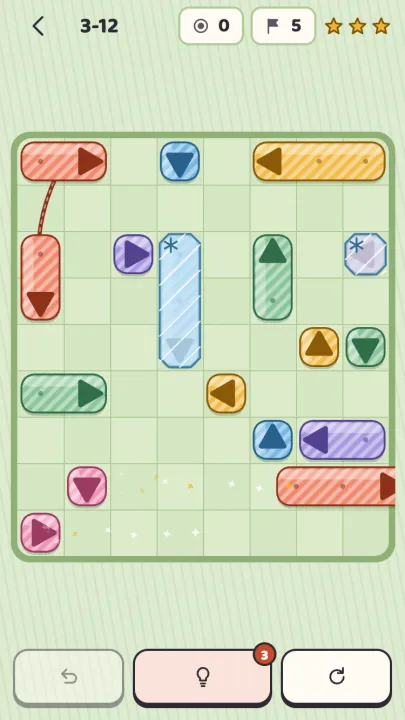
Arrows can be 2 or 3 cells long. When a long arrow is pushed sideways, its whole body moves and it pushes whatever is in front of each of its cells. So pushing a long arrow sideways makes a wide sweep. On many boards it is better to shove a long arrow from the side than to tap it directly.
Frost
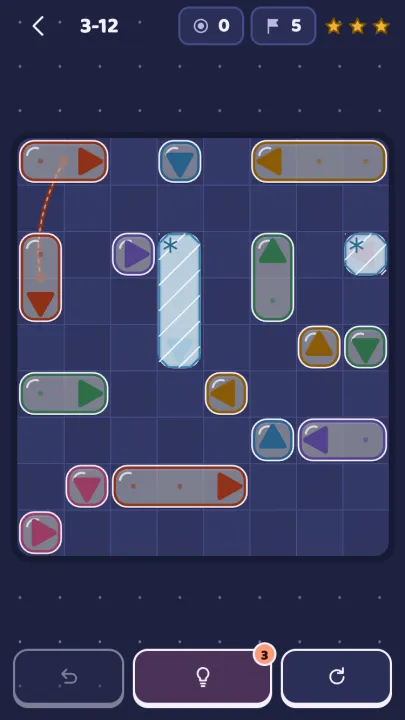
A frozen arrow (pale blue crystal shell) cannot be tapped. It shakes and crackles, and the tap is not counted. But it is swept away normally when another arrow pushes it. And when every unfrozen arrow is gone, all the frozen ones thaw at once.
Treat frozen arrows as something to be swept, not a wall to wait out. If you wait for them to thaw and then tap them one at a time, they cost a lot of taps. Get as many as you can into sweeps before they thaw.
Tether
Two arrows joined by a rope both slide at once when you tap either one. That is two sweeps for one tap, which makes tethers the key to par on these boards. But if one of the pair is swept off by another arrow first, the rope breaks. So tethered arrows are usually worth using early, before another sweep takes one of the pair.
Mixed
Long arrows, frost and tethers all appear together on the biggest boards (up to 10×12 cells and 28 arrows). An order that usually works: use the tethers, get frozen arrows into sweeps, make wide sweeps with long arrows, then tidy up what is left.
When you are stuck: Hints
A hint shows the best next move from where you are now. You start with 3, gain 1 for every 4 boards you clear, and can hold up to 5. In a given board, the first hint does not affect your stars, but from the second hint on that board is capped at 2 stars. So save hints for when you are truly stuck, and use one at a time. After a hint, take a moment to work out why that move was right. It makes the next board much easier.
Each world opens once you have 45 stars (half of 90) in the world before it. Clearing every board once usually leaves you a little short, so the fastest route is to replay two-star boards and turn them into three.
The Daily board
Everyone plays the same board each day, and the type depends on the weekday.
- Monday to Thursday: long arrow boards
- Friday and Saturday: frost boards
- Sunday: tether boards
Your result is shared as one line of emoji that never shows the board. Each tap is one square, colored by how many arrows it cleared (🟦 1, 🟩 2-3, 🟨 4-6, 🟧 7 or more). More orange means bigger sweeps. Clearing the Daily also keeps your streak going.
Summary
- Three stars = par or fewer. Undo and Restart are free.
- Tap the back of the line.
- A pushed arrow loses its own sweep, so protect arrows that are "the back" for others.
- Sweep frozen arrows before they thaw, and use tethers early.
- If you are stuck, take one hint and work out why it was right.
Arrow Sweep runs in your browser with nothing to install. A board takes from 15 seconds to about two minutes, which makes it a good fit for a short break.
Written by the JWorld team from our game design documents and measured play data, with AI tools helping with the writing.