How Korea's hwacha fired 100 rocket arrows at once, how it was actually used, and how we reimagined it as a moving fortress for our game, with a clear line between history and invention.
Hwacha Fortress, one of JWorld's action games, puts you in command of a giant wheeled Joseon siege fortress that has to survive ten minutes against an advancing army. Its name comes from a real weapon: the hwacha (화차, "fire cart") of Joseon-era Korea. This post first looks at what the historical hwacha actually was, then explains how we reimagined it for the game, and is honest about where history ends and invention begins.
A cart that fires
The hwacha was what its name says: a cart that used gunpowder. It was a two-wheeled cart carrying a frame that could launch many arrows or small gun barrels at once. The closest modern comparison is a mobile multiple-rocket launcher.
Records say a hwacha was built in 1409, under King Taejong, by Choe Hae-san. The design most people picture today is the improved version from 1451, under King Munjong, a king known for his interest in gunpowder weapons since his years as crown prince.
Two interchangeable launch frames
A clever feature of the Munjong hwacha was that the launch frame on the cart could be swapped.
| Launch frame | What it fired | Per volley |
|---|---|---|
| Singijeon frame | Medium or small singijeon rocket arrows | 100 arrows |
| Chongtong frame | 50 small gun barrels (sajeon chongtong), each loaded with 4 arrows | 200 arrows |
The cart was small enough for soldiers to push and pull, and the frame's angle could be raised or lowered to adjust the range. It is also said that it could be used as an ordinary cargo cart when not in battle. It was practical equipment that moved between fortresses and camps, not only a battlefield weapon.
Singijeon: arrows that fly themselves
The hwacha's signature ammunition was the singijeon (신기전, "divine machine arrow"): an arrow with a gunpowder tube attached, propelled by the burning powder. It grew out of the juhwa ("running fire") rocket from the gunpowder weapon program of Choe Mu-seon in the late Goryeo period, and received the name singijeon when it was improved in 1448, under King Sejong.
Singijeon came in several sizes: large, exploding, medium and small. The large singijeon was a rocket more than five meters long. The ones usually loaded into a hwacha were the much smaller medium and small types.
Part of what makes the singijeon and hwacha special is that their blueprints survive. The Gukjo Orye Seorye of 1474 includes an illustrated section on weapons (the Byeonggi Doseol) that records their structure and measurements down to very small units. Thanks to it, modern researchers have been able to rebuild them and test-fire them. Precise written designs of a rocket weapon from more than five centuries ago are rare anywhere in the world.
How the hwacha was used
The hwacha did not charge into enemy lines. It was used behind fortress walls and field defenses to pour dozens or hundreds of arrows at once into an advancing force and break its momentum. What mattered was not the accuracy of each arrow but covering a wide area all at once.
Accounts say hwacha were used at the Battle of Haengju (1593) during the Imjin War, when General Gwon Yul held a hill fortress with a small garrison against a much larger army. In that kind of defense, gunpowder weapons like the hwacha gave the defenders a great deal of strength.
In the game, what is invented?
Let us be upfront: Hwacha Fortress is not a historical simulation. The real hwacha was a two-wheeled cart pushed by people. It did not grow into a fortress, and it certainly did not ram and swallow enemies. The game started from one question: "What if the hwacha had been a moving castle instead of a cart?"
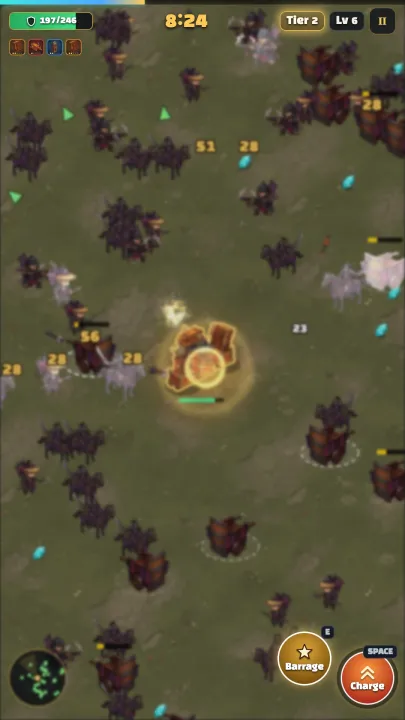
Here is how that idea became game rules.
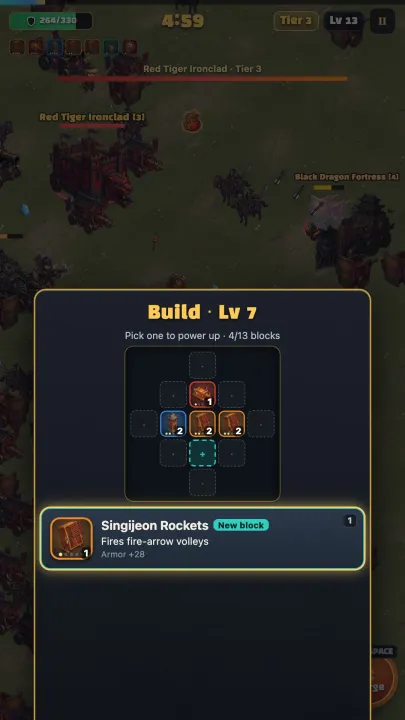
- Blocks are the fortress. When you level up, the block you pick from a card is physically attached to your fortress, and where it attaches (front, sides or rear) changes the direction it fires. The overwhelming, all-at-once firepower of singijeon and gun barrels comes straight from the historical hwacha.
- Your weight class grows. Each time your fortress passes 4, 6 and 9 blocks, it moves up a weight class. The camera pulls back, time slows for a moment, and the enemy pack that was a threat a second ago is now small enough to ram and swallow in one go. This "class reversal" is the heart of the game.
- Bosses are always one class above you. At 3:00, 6:00 and 9:00 an enemy fortress one class bigger than yours rolls in. Defeat it and it drops a chest that can evolve a block into its ★ form. Evolution needs a specific partner block attached to your fortress too, so choosing combinations matters.
- Light the beacons. Every clear lights one more beacon level (0 to 5). Each level adds a rule and raises the coin reward. The name borrows from Joseon's beacon-fire signal network.
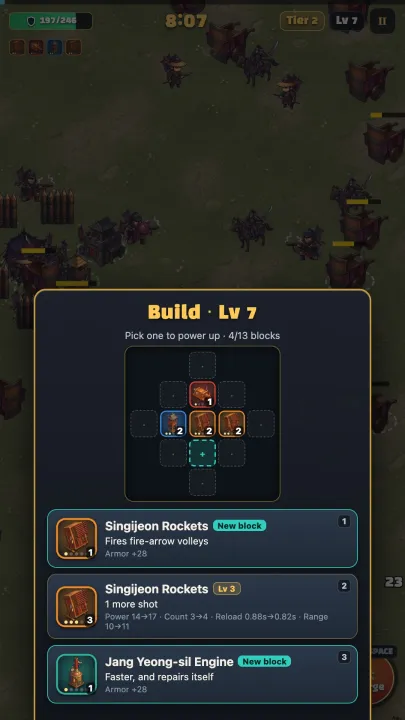
The game has 3 fortresses, 12 enemy types (including 3 bosses), 8 permanent upgrades, 25 achievements and a 39-entry codex, and a run lasts ten minutes. It is designed to be steered with one thumb on a phone held upright.
Why we build games from Korean history
JWorld makes several games from Korean folklore and history: Dokkaebi Night, Jangseung Guard and Hwacha Fortress among them. The reason is simple. Games around the world are full of knights, dragons and samurai, but the hwacha, the jangseung village guardian and the dokkaebi goblin are rare. Stories that feel familiar to Korean players are a fresh world to players everywhere else. Hwacha Fortress is available in 12 languages, and if a player somewhere stops to look up whether the hwacha was real, we think that is worth a lot.
When we mix in imagination, we keep one rule: the game's exaggerations stay inside the game, and in writing like this we separate history from invention.
Summary
- The hwacha was a Joseon gunpowder weapon: a two-wheeled cart that fired 100 singijeon or 50 small gun barrels at once (improved in 1451 under King Munjong).
- The singijeon was a rocket arrow improved in 1448 under King Sejong, and its design survives in the 1474 Byeonggi Doseol, which made modern reconstruction possible.
- Hwacha Fortress starts from the question "what if the hwacha were a moving castle?": a ten-minute survival game where you grow your fortress block by block, climb weight classes to swallow enemies, and light beacons.
Hwacha Fortress runs in your browser with nothing to install, and is also available on Google Play and the App Store.
Written by the JWorld team from our game design documents and measured play data, with AI tools helping with the writing.