How the tension needle in Bobber Rise really works, how to spot each of the five pull styles before it hits, and which gear to buy first, straight from the game's design numbers.
Bobber Rise is a fishing game played with a single press: hold to reel, release to ease off. It feels simple until the first time the line snaps on a fish you were sure you had, or a fish slips off the hook for no clear reason. We built the game, so this guide uses the actual design numbers to explain what is happening under the water: how to keep the needle in the safe band, how to read the five pull styles, and what order to buy gear in.
What happens in one cast
A single cast takes about 17 to 21 seconds from start to finish.
- Cast: a power meter swings back and forth. Tap to stop it and the line flies that far. The water has three zones: near (by the reeds), mid, and far (deep water).
- Wait: the bobber floats for 2 to 5 seconds, then dips. You get three cues at once: the bobber sinks, a chime plays, and the phone vibrates.
- Hook: tap the moment it dips. The bite window lasts between 0.6 and 1 second depending on the fish.
- Reel: hold to reel in, release to ease off. Keeping the tension needle inside the safe band is the whole game.
- Land: when the line is all the way in you get a catch card and coins. Every fish is released back into the water afterwards.
A visit is 8 casts, followed by a Rest stop screen. There is no energy system, so you can start the next visit right away.
Hooking: faster is better
The bite window (the "Hook window" stat) depends on the fish's rarity: Common 1.0 s, Uncommon 0.9 s, Rare 0.8 s, Epic 0.7 s, Legend 0.6 s. The rarer the fish, the less time you get.
There is a rule most players never notice: tap within the first 35% of the window and you get a good hook. A fish on a good hook starts the fight with only 90% stamina, so the fight is shorter, and it pays 10% more coins. Tapping the instant the bobber dips, without waiting to be sure, is the single habit that improves results the most.
A missed hook costs nothing. The fish swims off and you cast again.
Reeling: the needle and the safe band
While you reel, a vertical gauge sits on the right edge of the screen. The needle is the line tension. The bright band is the safe zone.
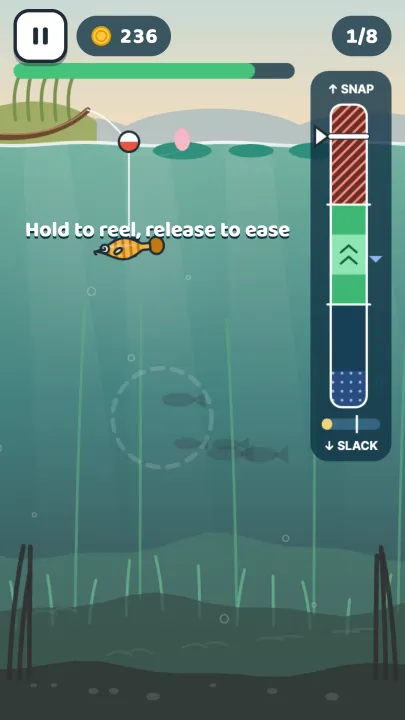
- Holding raises the tension and pulls line in.
- Releasing lowers the tension and lets a little line out.
- The fish only tires while the needle is inside the band, and it tires faster while you are holding.
- Near the middle of the band is a power zone where line comes in 1.5 times faster.
The band does not stay still. It drifts up and down on a cycle of about 5 seconds. That is why holding the whole time, or pressing to a fixed rhythm, does not work. You have to follow the band with your eyes.
The three ways to lose a fish
| What happens | When | How to avoid it |
|---|---|---|
| The line snaps | Tension stays above the band too long (about 1 second with starting gear) | When the needle reaches the red stripes or the warning plays, let go |
| Slack: the hook falls out | Tension stays very low for 0.9 seconds | Don't release for long. Short releases, then hold again |
| The fish gets away | The line goes 6 m further out than where the fight started, or the fight lasts over 24 seconds | Keep reeling inside the band to close the distance |
The warning fires once you have used 60% of the time your line can take. Simply releasing when you hear it saves almost every fish. But releasing too long makes the line go slack, so the basic rhythm is long holds, short releases.
Tired fish (below 35% stamina) swim toward the shore on their own while the needle is in the band. That is why the end of every fight feels easier than the start.
Reading the 5 pull styles
Every species has a fixed pull style. Once you catch a fish, its album page shows its Pull style, so the album doubles as a cheat sheet for the next time you meet it.
| Pull style | What you see | How to fight it |
|---|---|---|
| Steady | No special signal. The fish glides straight | Long holds, aimed at the middle of the band |
| Swaying | The tail sways and ripples spread left and right on the same beat | Release as the ripple swells, hold as it fades |
| Charging | The fish flashes and a ring ripple appears, then 0.35 s later it pulls hard | Let go the moment you see the flash. The charge is over in 0.55 s |
| Thrashing | The fish shakes its head with fast small ripples | The pull flips every 0.45 to 0.8 s, so use short taps |
| Diving | In the cutaway view the fish sinks for 1.8 s | Ease off gradually as it sinks, then hold long when it runs out of strength |
Charging fish snap more lines than anything else. A charge pulls at 3.6 times normal strength, but it is always announced 0.35 seconds ahead by a flash and a low "wub" sound. Let go as soon as you see the flash and the line almost never breaks.
Diving fish are also a chance to gain ground. After the dive, the fish goes limp for 0.6 seconds. Hold through that window and you can reel in a lot of line at once.
The six ponds and how to unlock them
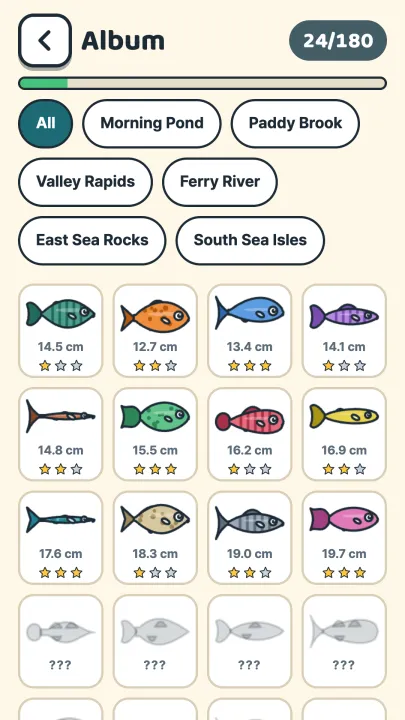
The game starts at Morning Pond and moves through six Korean waters. Each one needs coins and a minimum number of species in your album.
| Pond | Unlock | New pull style |
|---|---|---|
| Morning Pond | From the start | Steady, Swaying |
| Paddy Brook | 100 coins + 10 species | Charging |
| Valley Rapids | 250 coins + 30 species | Thrashing |
| Ferry River | 500 coins + 55 species | Diving |
| East Sea Rocks | 900 coins + 72 species | All five mixed |
| South Sea Isles | 1,500 coins + 98 species | All five, stronger |
Each pond has 30 species, 180 in total. A fish of the same rarity pulls harder in a later pond, but it also pays more: from 1.3 up to 2.9 times the coins. Your first catch of every species adds a discovery bonus, so early on, hunting species you have not caught yet is the fastest way to earn coins.
Time of day matters too. It changes every 4 casts between day, dusk and night. Each species has a favorite time and a favorite zone (near, mid or far). Check a missing fish's album page and cast at the right time and distance.
Gear: what to buy first
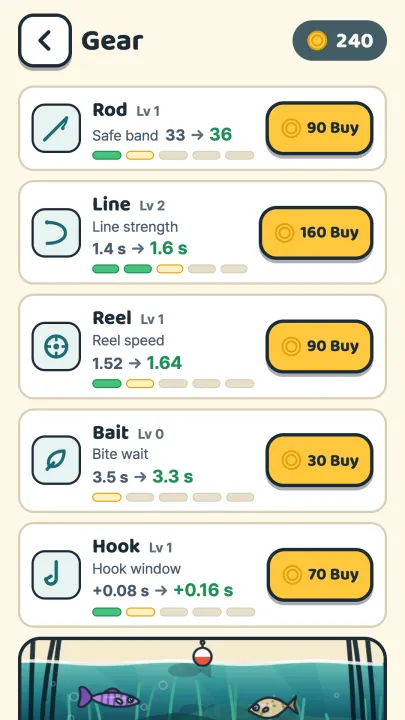
There are five gear tracks, each with 5 levels. Buying everything costs 5,500 coins.
| Gear | Per level | Buy it first if... |
|---|---|---|
| Rod | Wider safe band | You struggle to keep the needle in the band |
| Line | +0.2 s before a snap | Your line keeps breaking |
| Reel | +0.12 m/s reel speed (fights about 7% shorter) | Fish keep getting away |
| Bait | -0.2 s bite wait, +8% rare fish chance | You want to fill the album faster |
| Hook | +0.08 s bite window | You often miss the bite |
For a new player we recommend Rod, then Line, then Reel. The first upgrade costs 40 coins, which you usually have by your fourth cast. Rod and Line forgive mistakes, so they cut early failures the most. Reel shortens the long fights in later ponds. Bait and Hook cost 25% less than the others, so they are good buys with spare coins.
Gear never catches the fish for you. Even with every track maxed out, simply holding the whole time almost never lands a fish. The skill stays with the player.
Three stars in the Daily Pond
Once a day the Daily Pond opens. Everyone gets the same pond and the same fish on the same date, and everyone fishes with the same loaner gear (level 2 on every track), even in ponds you have not unlocked yet.
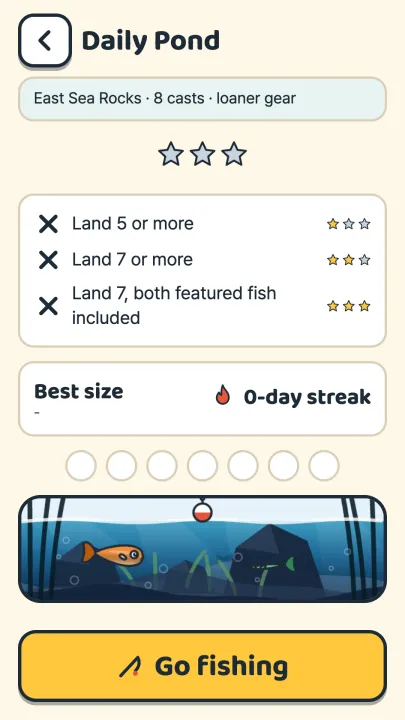
- 1 star: land 5 or more of 8
- 2 stars: land 7 or more
- 3 stars: land 7, both featured fish included
The two featured fish only bite on cast 3 and cast 6, and only if your cast lands inside the highlighted shoal ring. So three stars comes down to stopping the power meter in the ring on those two casts. You can relax on the others.
The coin reward (20, 40 or 80 coins depending on stars) is paid only on your first attempt of the day. Later attempts still fill your album, so they make good practice. You can copy your result as a single line and compare with friends.
Summary
- Tap the instant the bobber dips. A good hook means the fish starts at 90% stamina and pays +10% coins.
- Long holds, short releases. Let go when the needle hits the red stripes.
- A flash means a charge is coming. Let go.
- Early on, chase species you have not caught. Buy Rod, then Line, then Reel.
- In the Daily Pond, put casts 3 and 6 inside the ring.
Bobber Rise runs in your browser with nothing to install, and it is designed for one-handed play on a phone held upright.
Written by the JWorld team from our game design documents and measured play data, with AI tools helping with the writing.